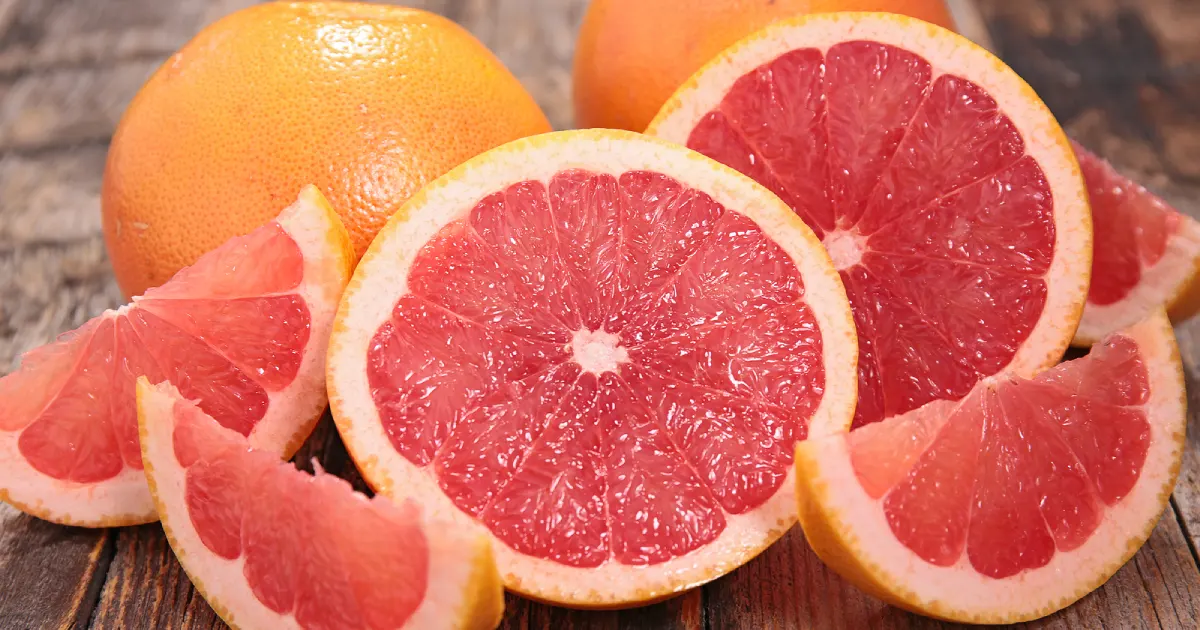
Grapefruit is a slightly tart and sweet citrus fruit that is actually a hybrid of oranges and pomelos.
A 123g half-fruit serving of grapefruit contains more than 40% of the Daily Value for vitamin C and also provides fiber and bioactive compounds. These bioactives include furanocoumarins and flavonoid polyphenols, such as naringin, narirutin, and hesperidin.
Scientific research has found that grapefruit may improve some markers of heart health, such as systolic blood pressure and pulse wave velocity. However, some of the bioactive compounds in grapefruit, such as furanocoumarins, can interact with medicine, so some people may need to limit intake.
In this article, we explain the potential benefits and downsides of grapefruit and present its full nutritional profile.
Potential Benefits of Grapefruit
Like several other types of fruit, grapefruit may have some potential health benefits.
Most of the available research on grapefruit has concentrated on its effect on markers of heart health, with some studies also investigating its impact on weight.
May Lower Blood Pressure
Grapefruit contains several compounds that may impact blood pressure, including potassium and naringin, which breaks down into naringenin.
Several small studies have assessed the impact of grapefruit consumption on blood pressure:
- Impact on systolic blood pressure: A systematic review of randomized controlled trials, involving 250 participants, found that grapefruit decreased systolic blood pressure by an average of 2.43 mmHg. While this drop is relatively modest, it can still be viewed as a beneficial change across a large number of people. However, the studies were short-term and it was unclear what the minimum effective dose of grapefruit is.
- Grapefruit + nitrate: A randomized crossover trial found that consuming grapefruit juice alongside nitrate-rich beet juice enhances the latter’s blood-pressure-lowering effect. Nitrate is a compound found in foods like beets that is thought to help lower blood pressure.
What this means: The above studies show that grapefruit intake may modestly lower systolic blood pressure. However, the effect is much smaller than, and does not compare with, conventional blood pressure medications.
May Support Artery Health
A small randomized crossover trial involving 48 healthy older women investigated the effect of consuming one of two drinks daily for two separate six-month periods:
- 340 ml grapefruit juice (rich in naringin)
- A control drink (no naringin, but equal calories and carbs)
The study had some notable findings:
- Improvements in arterial stiffness: After consuming the grapefruit juice for six months, the women had lower pulse wave velocity in their major arteries.
- Importance of pulse wave velocity: Pulse wave velocity refers to how fast blood pressure waves travel through the arteries as the heart pumps blood. It is a key marker of how elastic or stiff arteries are, and elevated levels are associated with all-cause mortality in U.S. adults.
- Why lower scores are better: Lower pulse wave velocity means that the blood pressure wave travelled slower, which is a sign of the arteries being more flexible and elastic.
What this means: In this study, daily grapefruit intake improved the elasticity of major arteries. Arterial flexibility is associated with better cardiovascular health, as stiffer arteries are less responsive in accommodating increased blood flow.
However, it is worth noting that this study found no changes in blood pressure or endothelial function (another marker of arterial flexibility).
Grapefruit and Cholesterol
Researchers investigated the effects of grapefruit on body weight, cholesterol, and blood pressure in a randomized controlled trial involving 74 adults with overweight.
During the study, participants consumed either:
- One-half of a red grapefruit with a meal three times per day for six weeks
- A control diet
However, after six weeks of grapefruit intake, no significant differences were found between the control and intervention group.
That said, both groups experienced improvements in health markers compared to baseline (the start of the study).
- Impact on cholesterol: Total cholesterol and low-density lipoprotein cholesterol (LDL-C) as well as systolic blood pressure were significantly lower.
- Weight changes: No changes in body weight were observed.
What this means: Compared to baseline, there were no changes in bodyweight, but there was a substantial drop (-18.7 mg/dL) in LDL-C. LDL-C is sometimes referred to as “bad cholesterol” because higher levels are recognized as a causal risk factor for cardiovascular disease.
This means that the beneficial effects were seen in both groups. There could be multiple explanations for this, including participants strictly following healthy habits knowing they are in a study.
Further reading: Such behavior-based effects are known as the Hawthorne effect.
That said, this study fails to confirm if grapefruit intake can lower LDL-C as there was no significant difference compared to the control diet.
Rich in Bioactive Compounds
As previously mentioned, grapefruit contains a range of bioactive compounds in notable amounts.
These include naringin, narirutin, and a class of compounds known as furanocoumarins. The most concentrated of these compounds is naringin. According to Phenol-Explorer, a database that displays the polyphenol contents of food, grapefruit contains 53 mg of naringenin per 100g.
Note: To avoid any confusion, ‘naringenin’ is just the active form of the compound that naringin breaks down into during digestion.
A 2025 systematic review found that naringin has antioxidant, anti-inflammatory, and vaso-protective (artery protective) effects.
The review found that, based on human trials, naringin appears to have beneficial effects on arterial stiffness, potentially supporting the findings on grapefruit and arterial health that we discussed earlier.
Additionally, red and pink-fleshed grapefruits get their pigment from a carotenoid with antioxidant properties called lycopene.
Fresh tomatoes are one of the best whole food sources, but grapefruit can contain nearly as much, with research recording their lycopene content at between 0.35–3.36 mg per 100g.
Related: Processed tomato products contain the most lycopene
Potential Downsides of Grapefruit
While we have looked at the benefits of grapefruit so far, it is important to understand that it can also have some drawbacks.
Two of the main considerations here are medical interactions and grapefruit’s acidity.
Medical Interactions
Some of the compounds in grapefruit can interact with medications.
In fact, research has shown that grapefruit interacts with more than 85 drugs.
These drug interactions can affect a wide range of medicine, including but not limited to medicines used to treat:
- Anxiety
- High blood pressure
- High cholesterol
- Organ transplant rejection
The reason for these interactions is primarily because of the furanocoumarins that grapefruit contains:
- How furanocoumarins interact with medications: These compounds can bind enzymes in the intestines, such as CYP3A4, which is an enzyme responsible for breaking down medications in the gut.
- The issue: Some medications are dosed higher to account for expected losses of the active ingredients as they are broken down by CYP3A4 before they can enter the bloodstream.
- Impact of furanocoumarins: As furanocoumarins bind CYP3A4, the enzyme cannot do its job of breaking down medications in the gut. This means that more of the active ingredients escape digestion and are taken into the blood, meaning patients consuming the medications may absorb substantially higher amounts of medication than expected.
It is also worth noting that:
- Some compounds in grapefruit, like naringin, can potentially lower the absorption rate of certain medications, such as the antihistamine fexofenadine.
- Consuming grapefruit at a different time to medication is not a reliable way to avoid interactions. This is because grapefruit juice intake has been shown to inhibit the CYP3A4 enzyme for at least 48 hours.
What this means: Grapefruit can either raise or lower the absorption of medications. Since it can interact with such a large number of medications, anyone using such medications should consult their healthcare provider before adding it to their diet. Additionally, users of medications should check labels and instructions carefully for the presence of any grapefruit interactions.
Acidity and Dental Erosion
While grapefruit isn’t quite as acidic as lemons and limes, it still has a highly acidic pH of approximately 2.9–3.2.
Such pH levels are acidic enough to potentially lead to tooth enamel erosion.
For example, a study assessing dental erosion immersed human teeth in different citrus juices, finding that grapefruit juice was more erosive than orange juice but not as erosive as lemon juice.
This does not mean that grapefruit can’t be part of a healthy diet, nor does it mean that it will damage teeth. However, regular consumption of grapefruit juice — or any kind of citrus juice — may raise the risk of tooth erosion.
Full Nutrition Facts
In this next section, we present the full nutritional profile for grapefruit per 100g and per 123g half-fruit. We have calculated Percent Daily Values (% DV).
Nutrition data source: USDA – Grapefruit, raw, pink and red, all areas
Calories and Macronutrients
| Nutrient | Per 100g (% DV) | Per 123g half-fruit (% DV) |
|---|---|---|
| Calories | 42 kcal | 52 kcal |
| Carbohydrates | 10.7g (4%) | 13.2g (5%) |
| Fiber | 1.6g (6%) | 1.97g (7%) |
| Sugars | 6.89g | 8.48g |
| Fat | 0.14g (<1%) | 0.17g (<1%) |
| Saturated | 0.02g (<1%) | 0.03g (<1%) |
| Monounsaturated | 0.02g | 0.03g |
| Polyunsaturated | 0.04g | 0.04g |
| Omega-3 | 0.01g | 0.01g |
| Omega-6 | 0.03g | 0.04g |
| Cholesterol | 0 mg (0%) | 0 mg (0%) |
| Protein | 0.77g (1%) | 0.95g (2%) |
Vitamins
| Vitamin | Per 100g (% DV) | Per 123g half-fruit (% DV) |
|---|---|---|
| Vitamin A (RAE) | 58 mcg (6%) | 71.3 mcg (8%) |
| Vitamin C | 31.2 mg (35%) | 38.4 mg (43%) |
| Vitamin D | 0 mcg (0%) | 0 mcg (0%) |
| Vitamin E | 0.13 mg (1%) | 0.16 mg (1%) |
| Vitamin K | 0 mcg (0%) | 0 mcg (0%) |
| Thiamin (B1) | 0.04 mg (3%) | 0.05 mg (4%) |
| Riboflavin (B2) | 0.03 mg (2%) | 0.04 mg (3%) |
| Niacin (B3) | 0.20 mg (1%) | 0.25 mg (2%) |
| Pantothenic acid (B5) | 0.26 mg (5%) | 0.32 mg (6%) |
| Vitamin B6 | 0.05 mg (3%) | 0.07 mg (4%) |
| Folate (B9) | 13 mcg (3%) | 16 mcg (4%) |
| Vitamin B12 | 0 mcg (0%) | 0 mcg (0%) |
| Choline | 7.7 mg (1%) | 9.47 mg (2%) |
As the table shows, grapefruit is high in vitamin C and contains several other vitamins in relatively small amounts.
Minerals
| Mineral | Per 100g (% DV) | Per 123g half-fruit (% DV) |
|---|---|---|
| Calcium | 22 mg (2%) | 27.1 mg (2%) |
| Iron | 0.08 mg (<1%) | 0.10 mg (1%) |
| Magnesium | 9 mg (2%) | 11.1 mg (3%) |
| Phosphorus | 18 mg (1%) | 22.1 mg (2%) |
| Potassium | 135 mg (3%) | 166 mg (4%) |
| Sodium | 0 mg (0%) | 0 mg (0%) |
| Zinc | 0.07 mg (1%) | 0.09 mg (1%) |
| Copper | 0.03 mg (3%) | 0.04 mg (4%) |
| Manganese | 0.02 mg (1%) | 0.03 mg (1%) |
| Selenium | 0.1 mcg (<1%) | 0.12 mcg (<1%) |
While grapefruit contains a broad range of minerals, they are only present in low amounts.
Is Grapefruit a Healthy Choice?
If you’re considering grapefruit, then its main benefits are:
- It’s high in vitamin C
- Small studies suggest it may improve some markers of cardiovascular health, such as systolic blood pressure
- It offers fiber and a good range of vitamins and minerals for relatively few calories
However, if you use any medications, particularly ones used to treat cholesterol, blood pressure, and anxiety, then grapefruit may potentially cause adverse interactions with these.
To be clear, this does not relate to every medication, and you should consult your healthcare provider to confirm.
For those who don’t take interacting medications, grapefruit can play a beneficial role in a healthy dietary pattern.
References
Full List of Scientific References (Select to Expand)
All citations used within this article are listed below, with full details for each scientific source.
- Hui Liu et al. (2022). Naringenin protects against hypertension by regulating lipid disorder and oxidative stress in a rat model. View study in Kidney and Blood Pressure Research journal
- Igho Onakpoya et al. (2017). The effect of grapefruits (Citrus paradisi) on body weight and cardiovascular risk factors: A systematic review and meta-analysis of randomized clinical trials. View study in Critical Reviews in Food Science and Nutrition journal
- Kevin O’Gallagher et al. (2020). Grapefruit juice enhances the systolic blood pressure-lowering effects of dietary nitrate-containing beetroot juice. View study in the British Journal of Clinical Pharmacology
- Veronique Habauzit et al. (2015). Flavanones protect from arterial stiffness in postmenopausal women consuming grapefruit juice for 6 mo: a randomized, controlled, crossover trial. View study in the American Journal of Clinical Nutrition
- Kai Liu et al. (2025). Elevated pulse wave velocity as a marker of arterial stiffness and its association with mortality in US adults. View study in Scientific Reports journal
- Caitlin A. Dow et al. (2012). The effects of daily consumption of grapefruit on body weight, lipids, and blood pressure in healthy, overweight adults. View study in Metabolism journal
- Jim McCambridge et al. (2014). Systematic review of the Hawthorne effect: New concepts are needed to study research participation effects. View study in the Journal of Clinical Epidemiology
- Ram M. Uckoo et al. (2012). Grapefruit (Citrus paradisi) phytochemicals composition is modulated by household processing techniques. View study in the Journal of Food Science
- Phenol-Explorer. (n.d.). All polyphenols found in Grapefruit. View Phenol-Explorer data
- Jose A. Adams et al. (2025). Endothelial and cardiovascular effects of naringin: A systematic review. View study in Nutrients journal
- Mercy Omoye Shafe et al. (2024). Lycopene: A potent antioxidant with multiple health benefits. View study in the Journal of Nutrition and Metabolism
- David G. Bailey et al. (2013). Grapefruit-medication interactions: Forbidden fruit or avoidable consequences?. View study on PubMed
- Sabine Berteina-Raboin. (2025). Flavonoids and furanocoumarins involved in drug interactions. View study in Molecules journal
- Shimako Tanaka et al. (2013). Comparison of inhibitory duration of grapefruit juice on organic anion-transporting polypeptide and cytochrome P450 3A4. View study in Biological and Pharmaceutical Bulletin journal
- Avanija Reddy et al. (2015). The pH of beverages available to the American consumer. View study on PubMed
- Mohamed A Bassiouny et al. (2008). Topographic and radiographic profile assessment of dental erosion. Part II: Effect of citrus fruit juices on human dentition. View study on PubMed
- USDA FoodData Central. (2019). Grapefruit, raw, pink and red, all areas. View USDA data