In this article, we examine whether there is evidence for quinoa having benefits, covering areas including blood sugar management, cardiovascular health, and gut health.
We also present quinoa’s full nutrition facts, from its high fiber and magnesium content to its provision of protein, how it compares to other grains, and more.
Quinoa is sometimes called a pseudocereal because it is botanically a seed rather than a grain. However, it is used like a whole grain for culinary purposes and it provides many of the same nutrients that whole grains provide.
Table of contents
Key Nutritional Benefits
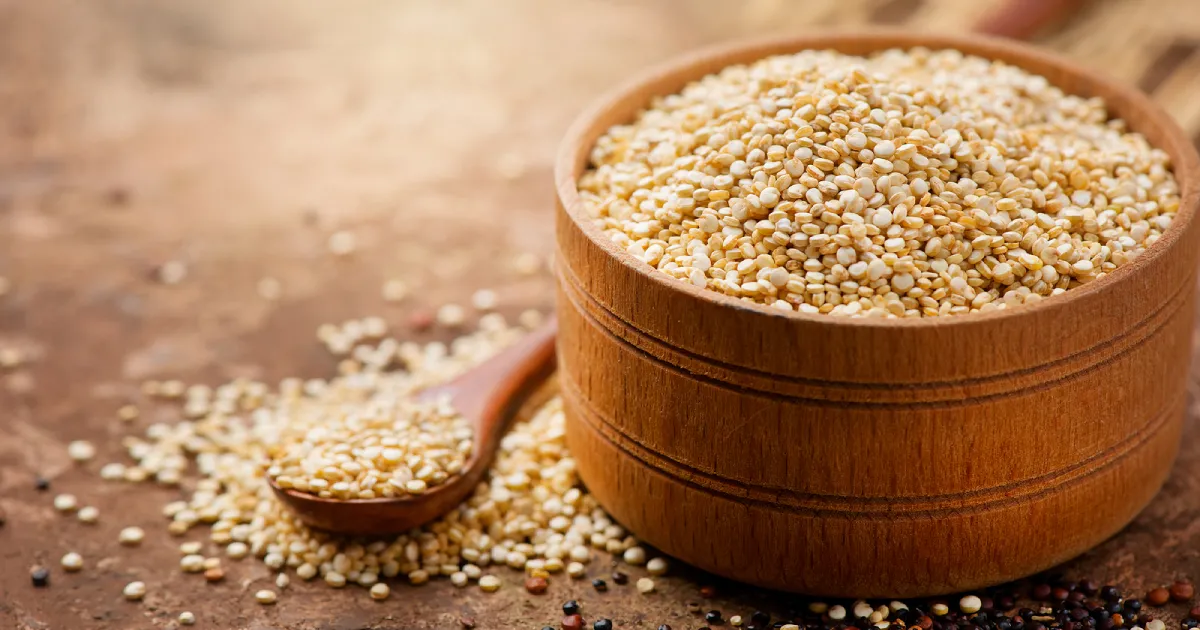
Based on USDA data for a 185g cup serving of cooked quinoa, the primary nutrients it provides in higher amounts include protein, fiber, copper, magnesium, manganese, and phosphorus.
- Moderate protein source: Cooked quinoa provides a moderate amount of protein, with around 8 grams per serving.
- Rich in fiber: Quinoa is a rich source of fiber, offering 5.18 grams per serving. This is equivalent to 19% of the daily value for fiber, which is based on a typical 2,000-calorie diet.
- High in magnesium, manganese, phosphorus, and copper: Quinoa offers high levels of magnesium, phosphorus, and copper, providing 28%, 51%, 22%, and 39% of the daily value for all four, respectively.
A cup serving of quinoa provides 222 calories.
Potential Benefits and Research Findings
Several systematic reviews and randomized controlled trials have investigated the potential benefits of quinoa consumption in recent years.
In this section, we review what they found, how strong that evidence is, and what potential benefits quinoa may provide.
Blood Sugar Management
A 2024 systematic review of seven clinical trials, involving 258 adults, found:
- Fasting blood glucose: A “dose-response” beneficial effect on blood sugar levels, which was observed when quinoa intake was close to 25 grams per day.
- Body weight and BMI: No beneficial impacts on body weight or body mass index (BMI) were seen.
However, despite this being a systematic review, the overall data available was relatively small. This is because there were just 258 people involved across all seven trials, and each study used only 15–50 grams of quinoa.
Recently, a 2024 randomized controlled trial helped build the evidence in this regard. This large trial involved 207 people with impaired glucose tolerance who were assigned to consume either 100 grams of quinoa or 100 grams of ‘other whole grains’ per day.
After one year of follow-up, compared to the other whole grain group and a control group, the quinoa group experienced significantly improved:
- Post-meal glucose levels
- Insulin sensitivity
- Lower prevalence of developing diabetes
Nutritionist’s Note
While further research with higher participation levels would help confirm the findings, the above studies do suggest that quinoa may help support healthy blood glucose levels.
This may be due to a combination of quinoa’s fiber and magnesium content in addition to being slightly lower in carbohydrates compared to common grains like rice:
- Total carbohydrates: The smaller absolute amount of carbohydrate in quinoa compared to grains like rice would lower total carbohydrate intake.
- Fiber: Quinoa is a rich source of dietary fiber, which may help to reduce large elevations in blood glucose after a carbohydrate-containing meal.
- Magnesium: Quinoa is high in magnesium. A systematic review demonstrated that magnesium supplementation can help to lower blood glucose levels and improve glucose tolerance in people with diabetes.
Cardiovascular Health
A 2020 systematic review of five clinical trials investigated the effect of quinoa consumption on cardiovascular disease risk factors.
The review found that quinoa intake led to slight improvements in several traditional cardiovascular risk markers.
These included body weight, waist circumference, total cholesterol, and LDL cholesterol (LDL-C), which is sometimes known as “bad cholesterol.”
However, the five trials included in the review only involved a low total of 206 participants. While meaningful, the absolute changes in weight (mean: -1.26kg) and LDL-C (mean: -3.08 mg/dl) were also relatively minor clinically.
Based on the available evidence and what we know about quinoa’s nutritional profile, the data suggests it would be beneficial for cardiovascular health compared to refined grains. However, its impact compared to other, healthy foods is difficult to measure.
Gut Health
Some research involving human participants has investigated quinoa’s impact on gut health and the microbiome: the colonies of bacteria that live within the gut, some of which can be beneficial.
A 2022 randomized controlled crossover trial gave 28 participants either a quinoa-enriched wheat bread roll (20g quinoa) or a wheat-only roll for four weeks, finding that:
- There were no significant differences in the gut microbiome before and after the study. This means the types and amounts of bacteria in the gut didn’t really change.
- The results didn’t support quinoa, at a dose of 20g, being able to significantly impact overall gut health.
The total amounts of quinoa used in this study were relatively small, and it is possible that higher amounts may have had a more significant effect. However, this is something that requires confirmation rather than presumption.
A later 2024 randomized pilot study found that a ‘quinoa-based cookie’ improved the gut microbiome by encouraging greater diversity, but this was in comparison to a ‘high fat-containing cookie.’
It is difficult to evaluate the relevance of this finding, as any high-fiber cookie would likely have had a similar effect.
Inflammation
Inflammatory responses are the body’s natural way of dealing with distress: from wounds to viruses, inflammation is part of the way the immune system works.
However, when inflammation levels are persistently high (chronic inflammation), this keeps the body under stress, and it has been linked to a higher risk of chronic disease.
A 2022 systematic review of animal and cell (test tube) studies found that quinoa intake had a beneficial inflammation-lowering effect.
However, we cannot assert that findings from preclinical (animal and cell) studies would be the same in human participants. So, while the finding is interesting and should likely stimulate further research, it doesn’t tell us that quinoa has an anti-inflammatory effect in humans.
Nutritional Profile of Quinoa
The tables below present the full nutritional values of cooked quinoa per 100g and per 185g cup. The source for all nutritional data is the USDA’s FoodData Central entry for cooked quinoa.
We have also calculated percent daily values (% DV), which are based on a 2,000-calorie diet and the FDA’s currently published daily values.
Calories and Macronutrients
| Nutrient | Per 100g (% DV) | Per 185g cup (% DV) |
|---|---|---|
| Calories | 120 kcal | 222 kcal |
| Carbohydrate | 21.3g (8%) | 39.4g (14%) |
| Fiber | 2.8g (10%) | 5.18g (19%) |
| Sugars | 0.87g | 1.61g |
| Fat | 1.92g (2%) | 3.55g (5%) |
| Saturated fat | 0.23g (1%) | 0.43g (2%) |
| Monounsaturated fat | 0.53g | 0.98g |
| Polyunsaturated fat | 1.08g | 2.0g |
| Omega-3 | 0.09g | 0.16g |
| Omega-6 | 0.97g | 1.8g |
| Protein | 4.4g (9%) | 8.14g (16%) |
| Cholesterol | 0 mg (0%) | 0 mg (0%) |
| Vitamin | Per 100g | Per 185g cup |
|---|---|---|
| Vitamin A (RAE) | 0 mcg (0%) | 0 mcg (0%) |
| Vitamin C | 0 mg (0%) | 0 mg (0%) |
| Vitamin D | 0 mcg (0%) | 0 mcg (0%) |
| Vitamin E | 0.63 mg (4%) | 1.16 mg (8%) |
| Vitamin K | 0 mcg (0%) | 0 mcg (0%) |
| Thiamin (B1) | 0.11 mg (9%) | 0.20 mg (17%) |
| Riboflavin (B2) | 0.11 mg (8%) | 0.20 mg (15%) |
| Niacin (B3) | 0.41 mg (3%) | 0.76 mg (5%) |
| Pantothenic acid (B5) | — | — |
| Vitamin B6 | 0.12 mg (7%) | 0.23 mg (14%) |
| Folate (B9) | 42 mcg (11%) | 77.7 mcg (19%) |
| Vitamin B12 | 0 mcg (0%) | 0 mcg (0%) |
| Choline | 23 mg (4%) | 42.6 mg (8%) |
Minerals
| Mineral | Per 100g | Per 185g cup |
|---|---|---|
| Calcium | 17 mg (1%) | 31.4 mg (2%) |
| Iron | 1.49 mg (8%) | 2.76 mg (15%) |
| Magnesium | 64 mg (15%) | 118 mg (28%) |
| Phosphorus | 152 mg (12%) | 281 mg (22%) |
| Potassium | 172 mg (4%) | 318 mg (7%) |
| Sodium | 7 mg (<1%) | 13 mg (<1%) |
| Zinc | 1.09 mg (10%) | 2.02 mg (18%) |
| Copper | 0.19 mg (21%) | 0.36 mg (40%) |
| Manganese | 0.63 mg (27%) | 1.17 mg (51%) |
| Selenium | 2.8 mcg (5%) | 5.18 mcg (9%) |
Potential Drawbacks and Other Considerations
Quinoa is quite distinct from some true grains in that it isn’t a source of gluten, but it does have some allergenic potential due to specific allergens it contains.
Quinoa is Gluten-Free
Unlike some whole grains such as barley and rye, quinoa is naturally gluten-free.
In a study involving nineteen people with celiac disease, consuming 50 grams of quinoa daily for six weeks was “well tolerated.”
However, individuals with celiac disease or gluten sensitivities should carefully check any quinoa product’s label for any potential cross-contamination statements.
In this regard, Beyond Celiac advises caution due to the fact that quinoa is often grown alongside other gluten-containing grains.
Potential for Allergies
Although allergies to quinoa are uncommon, they have been reported.
Pre-clinical animal studies have identified specific quinoa proteins, such as 11S globulins, with allergenic potential.
These proteins have also shown potential cross-reactivity with allergens found in peanuts and tree nuts. However, this is animal research and needs confirmation from further human studies.
Anyone with concerns about a potential quinoa allergy should consult their healthcare provider before consuming it.
How Quinoa Compares to Other Grains
You may wonder how quinoa’s nutritional profile compares to other whole grains and pseudocereals, so here’s a quick comparison table for your reference.
The table below shows how quinoa compares to several grain products that are used in similar culinary ways: Brown rice, buckwheat, and millet.
We have also included couscous as a comparison, which is technically a type of pasta but it is typically used in a similar way in the kitchen.
For each food, you can see its calorie, carbohydrate, fiber, and protein content per 100 grams (cooked weight).
| Nutrient | Calories | Carbs | Fiber | Protein |
|---|---|---|---|---|
| Brown rice | 123 kcal | 25.76g | 1.0g | 2.43g |
| Buckwheat | 92 kcal | 19.9g | 2.7g | 3.38g |
| Couscous | 112 kcal | 23.2g | 1.4g | 3.79g |
| Millet | 119 kcal | 23.7g | 1.3g | 3.51g |
| Quinoa | 120 kcal | 21.3g | 2.8g | 4.4g |
Sources: USDA brown rice, USDA buckwheat, USDA couscous, USDA millet, and USDA quinoa nutritional datasets.
As this nutritional data shows, quinoa contains slightly more fiber and protein per 100 grams than foods used in a similar way. Compared to brown rice, it has almost triple the fiber content and nearly twice as much protein.
Summary
Quinoa is a nutrient-rich pseudocereal, providing an excellent source of copper, magnesium, manganese, and phosphorus.
It also typically contains higher levels of fiber and protein than grains used in a similar culinary way, such as brown rice and millet.
In addition to its nutritional properties, research suggests quinoa may play a role in supporting cardiovascular health and blood sugar management. However, further research is necessary in these areas to provide greater clarity.
References
Full List of Scientific References
(Click to Expand)
All citations used within this article are listed below, with full details for each scientific source.
- USDA. (2019). Quinoa, cooked. View USDA data
- Masoumeh Atefi et al. (2023). Does quinoa (Chenopodium quinoa) consumption improve blood glucose, body weight and body mass index? A systematic review and dose-response meta-analysis of clinical trials. View study in Current Medicinal Chemistry journal
- Lu Huang et al. (2024). Quinoa is more effective than other whole grains in the management of impaired glucose tolerance: A randomized controlled trial. View study in Food & Function journal
- Ting Mao et al. (2021). Effects of dietary fiber on glycemic control and insulin sensitivity in patients with type 2 diabetes: A systematic review and meta-analysis. View study in the Journal of Functional foods
- Nicola Veronese et al. (2021). Oral magnesium supplementation for treating glucose metabolism parameters in people with or at risk of diabetes: A systematic review and meta-analysis of double-blind randomized controlled trials. View study in Nutrients journal
- Jahangir Karimian et al. (2021). The effects of quinoa seed supplementation on cardiovascular risk factors: A systematic review and meta-analysis of controlled clinical trials. View study in Phytotherapy Research journal
- Liangkui Li et al. (2022). Impact of daily consumption of whole-grain quinoa-enriched bread on gut microbiome in males. View study in Nutrients journal
- M.V. Espada et al. (2024). Cheopodium quinoa’s ingredients contribute to the gut microbiota’s metabolic adaptations on carbohydrate metabolism. View study in Plant Foods for Human Nutrition journal
- Aida Malek Mahdavi et al. (2022). Effects of quinoa (Chenopodium quinoa) on inflammatory mediators: A systematic review of preclinical studies. View study in Inflammopharmacology journal
- Nathalie Michels et al. (2021). Chronic inflammation towards cancer incidence: A systematic review and meta-analysis of epidemiological studies. View study in Critical Reviews in Oncology/Hematology journal
- Chang Liu et al. (2022). An overview of the nutritional profile, processing technologies, and health benefits of quinoa with an emphasis on impacts of processing. View study in Critical Reviews in Food Science and Nutrition journal
- Victor F. Zevallos et al. (2014). Gastrointestinal effects of eating quinoa (Chenopodium quinoa) in celiac patients. View study in the American Journal of Gastroenterology
- Beyond Celiac. (n.d.). Is quinoa gluten-free? View information at Beyond Celiac
- C. Astier et al. (2009). First case report of anaphylaxis to quinoa, a novel food in France. View case report in the European Journal of Allergy and Clinical Immunology
- Anne-Sofie Ravn Ballegaard et al. (2023). Allergenicity evaluation of quinoa proteins – a study in brown Norway rats. View study in Food and Chemical Toxicology journal
- USDA. (2019). Rice, brown, cooked, no added fat. View USDA data
- USDA. (2019). Buckwheat groats, roasted, cooked. View USDA data
- USDA. (2019). Couscous, cooked. View USDA data
- USDA. (2019). Millet, cooked. Nutrients in cooked millet