Asparagus is a green vegetable that provides high amounts of folate and vitamin K. It also contains a range of bioactive compounds (such as asparagosides).
Asparagus is typically more expensive than common staple vegetables, but does the extra expense get you more nutritional value?
This article takes an in-depth look at the scientific research on asparagus and discusses its potential benefits and full nutritional profile.
Table of contents
Potential Benefits
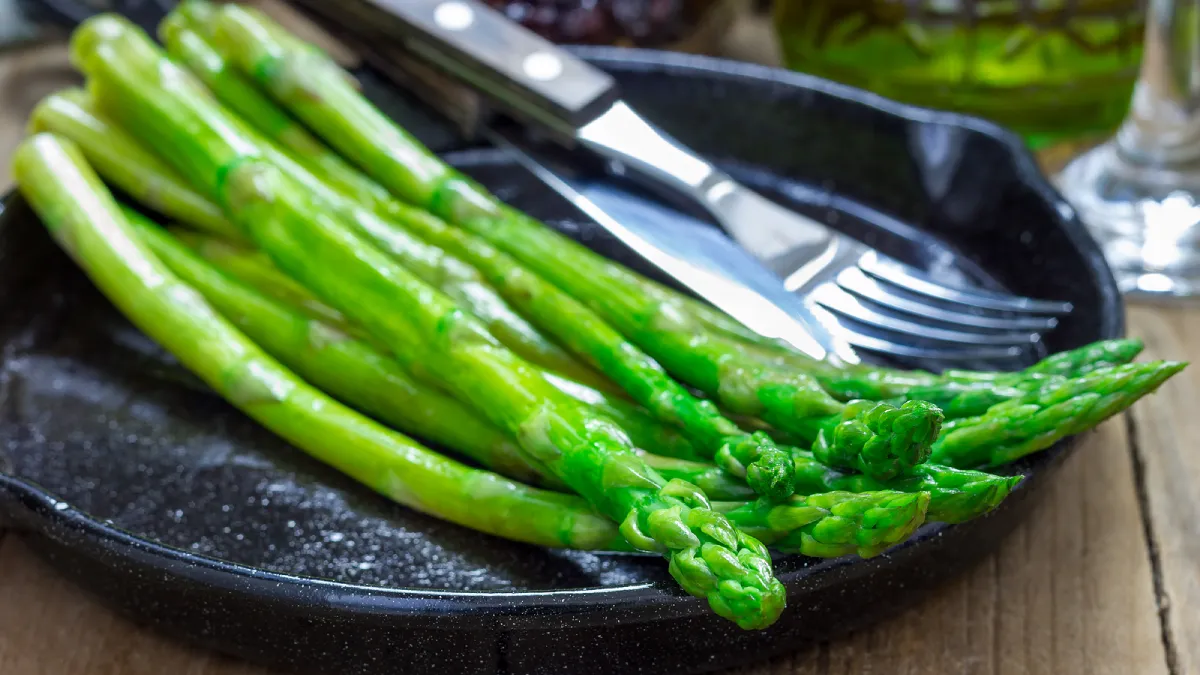
First, let’s look at some of the potential benefits of asparagus.
High Folate Content
Asparagus is a rich source of folate, with just four cooked spears (60g) providing 89 mcg – 22% of the daily value.
Folate has many functions within the body, but it is well-known for its potential to support healthy pregnancies. This is because consuming a sufficient intake of folate can help to lower the risk of complications such as neural tube defects.
However, it is worth noting that the Centers for Disease Control and the World Health Organization recommend that women supplement at least 400 mcg of folic acid (a form of folate) before and during pregnancy.
This is because folate needs increase during pregnancy, and folate within whole food isn’t as bioavailable as supplementary folic acid. In fact, folic acid can be more than 50% more bioavailable.
Credentialed Nutritionist’s Take
- Asparagus is an excellent source of folate: To avoid any confusion, let’s quickly tackle the differences between folate and folic acid, as I know some people find it confusing. Although folic acid is more bioavailable than folate in food, that doesn’t dismiss the importance of asparagus’s folate content. Most people don’t take folic acid supplements, and incorporating asparagus into your diet is an excellent way to increase folate intake.
- Pregnancy and nuance: Equally, it is important for women who are pregnant or planning on pregnancy to follow public health guidance. I know it is natural that some of you may think “isn’t my diet enough?” The fact is that guesswork isn’t as reliable; folic acid supplementation at 400 mcg per day is the safest way to ensure sufficient folate intake.
Note on folate: For more vegetable options, green peas and Brussels sprouts also provide a good amount of folate. Additionally, folate is water-soluble, meaning that boiling asparagus in water will result in greater folate loss. Cooking methods like steaming, stir-frying and roasting can help to preserve the most folate.
A Prebiotic Source
Asparagus is a rich source of inulin, a type of soluble fiber.
Inulin isn’t digested by the body’s enzymes and passes through the digestive tract to the colon (large intestine). Here, it acts as a prebiotic by feeding the gut bacteria present there.
Gut bacteria are often collectively called ‘microbiota’ or ‘the microbiome.’ Inulin is thought to increase the abundance and diversity of beneficial bacteria types in the gut.
Recent research indicates that prebiotic intake may translate to potential health benefits. For example, a 2025 systematic review of 29 randomized controlled trials found that prebiotic supplementation:
- Improved gut bacteria composition: Supplementation increased the presence of ‘beneficial bacteria’ like Bifidobacterium.
- Improved inflammatory response: Prebiotic supplementation was associated with a lower level of interleukin-1 beta (IL-1β), a marker of inflammation. It also increased levels of interleukin-10, a protein with anti-inflammatory properties.
A Source of Asparagosides and Polyphenols
Asparagus is a unique source of some bioactive compounds known as asparagosides, also known as ‘asparagus saponins.’
While mostly concentrated in the roots of asparagus, asparagosides are also present in the spears – the vegetable part we consume.
Likewise, asparagus is a source of polyphenols (sometimes known as “antioxidants” or “phytochemicals”) including:
- Flavonoids
- Phenolic acids
Flavonoids and phenolic acids have both been associated with potential health benefits, though there is limited evidence for asparagosides.
However, the amount of these compounds found within asparagus spears is low, and far below the doses used to assess benefits in research.
That said, dietary patterns high in polyphenols are associated with better long-term health outcomes, and asparagus is a dietary contributor of these compounds.
May Support Heart Health
A 2025 randomized controlled trial investigated the effect of asparagus powder made from freeze-dried asparagus spears on health markers. Over 12 weeks, adults with overweight or obesity supplemented 40 mg asparagus powder per kg of bodyweight.
After 12 weeks, the results indicated:
- Lipid improvements: Participants supplementing asparagus powder saw a significant reduction in “bad” LDL cholesterol.
- Better blood sugar regulation: An oral glucose tolerance test (OGTT) indicated that asparagus powder supplementation lowered the blood glucose response to pure glucose.
The researchers noted that this is the first study they’re aware of on this topic, and that further, longer-term trials are necessary. Note: This means that while the results look promising, they need confirming by larger studies.
Nutritionist’s Take: Whole Asparagus vs. Dried Powder
You may wonder “how much whole asparagus is asparagus powder equal to?” That’s a good question, and we can’t be 100% certain.
However, we can make a best guess based on the information we do have, so let’s take a look:
- The dose: Participants consumed 40 mg of asparagus powder per kg of bodyweight. For someone weighing 65 kg (143 lbs), this would be 2,600 mg of asparagus powder (2.6 grams).
- The fresh equivalent: According to USDA data, raw asparagus is 93.2% water by weight. That means the dried solids from 100 grams of raw asparagus are approximately 6.8 grams. If the fresh equivalent to 6.8 grams of dried asparagus is 100 grams, then a daily 2.6 grams of dried asparagus powder is equal to 38 grams fresh (2-3 medium spears as per USDA weights).
Nutrition Profile
Now that we know a bit about the potential benefits of asparagus, let’s take a look at all the different nutrients it contains.
Based on USDA data for cooked asparagus, the following tables show the full nutritional values of cooked asparagus per 100g and per 4 spear (60g) serving.
Calories and Macronutrients
| Nutrient | Per 100g (% DV) | Per 4 spears (60g) (% DV) |
|---|---|---|
| Calories | 22 kcal | 13 kcal |
| Carbohydrates | 4.11g (1%) | 2.47g (1%) |
| Fiber | 2.0g (7%) | 1.2g (4%) |
| Sugars | 1.3g | 0.78g |
| Fat | 0.22g (<1%) | 0.13g (<1%) |
| Saturated fat | 0.05g (<1%) | 0.03g (<1%) |
| Monounsaturated fat | 0g | 0g |
| Polyunsaturated fat | 0.11g | 0.06g |
| Omega-3 | 0.03g | 0.02g |
| Omega-6 | 0.08g | 0.05g |
| Protein | 2.4g (5%) | 1.44g (3%) |
| Cholesterol | 0 mg (0%) | 0 mg (0%) |
Vitamins
| Vitamin | Per 100g | Per 4 spear (60g) serving |
|---|---|---|
| Vitamin A (RAE) | 50 mcg (6%) | 30 mcg (3%) |
| Vitamin C | 7.7 mg (9%) | 4.62 mg (5%) |
| Vitamin D | 0 mcg (0%) | 0 mcg (0%) |
| Vitamin E | 1.5 mg (10%) | 0.9 mg (6%) |
| Vitamin K | 50.6 mcg (42%) | 30.4 mcg (25%) |
| Thiamin (B1) | 0.16 mg (13%) | 0.10 mg (8%) |
| Riboflavin (B2) | 0.14 mg (11%) | 0.08 mg (6%) |
| Niacin (B3) | 1.08 mg (7%) | 0.65 mg (4%) |
| Pantothenic acid (B5) | 0.23 mg (5%) | 0.14 mg (3%) |
| Vitamin B6 | 0.08 mg (5%) | 0.05 mg (3%) |
| Folate, DFE (B9) | 149 mcg (37%) | 89.4 mcg (22%) |
| Vitamin B12 | 0 mcg (0%) | 0 mcg (0%) |
| Choline | 26.1 mg (5%) | 15.7 mg (3%) |
With more than 20% of the daily value per serving, asparagus is high in folate and vitamin K. Aside from this, it is low (<5%) in most other vitamins except for thiamin, riboflavin, and vitamins C and E.
Minerals
| Mineral | Per 100g | Per 4 spear (60g) serving |
|---|---|---|
| Calcium | 23 mg (2%) | 13.8 mg (1%) |
| Iron | 0.91 mg (5%) | 0.55 mg (3%) |
| Magnesium | 14 mg (3%) | 8.4 mg (2%) |
| Phosphorus | 54 mg (4%) | 32.4 mg (3%) |
| Potassium | 224 mg (5%) | 134 mg (3%) |
| Sodium | 14 mg (1%) | 8.4 mg (<1%) |
| Zinc | 0.6 mg (5%) | 0.36 mg (3%) |
| Copper | 0.17 mg (19%) | 0.10 mg (11%) |
| Manganese | 0.15 mg (7%) | 0.09 mg (4%) |
| Selenium | 6.1 mcg (11%) | 3.66 mcg (7%) |
Per 4 spear (60g) serving, asparagus is low (<5% DV) in most minerals. However, it contains moderate amounts of copper and selenium.
Potential Drawbacks
There are no significant drawbacks of asparagus for most people:
- It contains no nutrients of concern for overconsumption
- Allergies are very rare
- It is a low-calorie source of several essential nutrients
However, out of an abundance of caution, here are a couple of scenarios for consideration:
Rare Allergies
While very rare, there have been several documented cases of asparagus allergy. The specific allergens in asparagus include proteins such as:
- Aspa o 1
- Aspa o 2
- Aspa o 4
Always consult your healthcare provider if you suspect an allergy to asparagus or any specific food.
Vitamin K and Medical Interactions
Asparagus contains high amounts of vitamin K, which can interact with medications such as warfarin and other blood thinners.
This is because vitamin K has functions that support blood clotting, the opposing effect of blood thinning medications.
For this reason, suddenly adding high amounts of vitamin K to the diet or frequently changing intake levels may impact how the medicine works.
Individuals using medication that requires as assessment of vitamin K intake should consult with their healthcare provider before adding asparagus to their diet.
Summary
Back in the introduction, I asked of asparagus: “does the extra expense get you more nutritional value?”
Compared to other green vegetables, the answer is not really. However, that doesn’t mean asparagus isn’t worth adding to your diet:
- It contains significant amounts of folate and vitamin K
- It has a pleasant flavor that many people enjoy.
- As a food pairing, it is considered to work well with protein options including meat, fish, and tofu.
All in all, several spears of asparagus add very few calories to the diet while adding a broad range of nutrients – some in notable amounts.
References
Full List of Scientific References
(Click to Expand)
All citations used within this article are listed below, with full details for each scientific source.
- USDA FoodData Central (2019). Asparagus, cooked, boiled, drained – nutrients. View USDA data
- CDC. (2025). Neural tube defects. View CDC information
- CDC. (2025). About folic acid. View CDC information
- World Health Organization. (2023). Periconceptional folic acid supplementation to prevent neural tube defects. View WHO information
- National Academy of Sciences. (1998). Dietary reference intakes for thiamin, riboflavin, niacin, vitamin B6, folate, vitamin B12, pantothenic acid, biotin, and choline. View National Academies information
- Araceli Redondo-Cuenca et al. (2023). Nutritional composition of green asparagus, edible part and by-products, and assessment of their effect on the growth of human gut-associated bacteria. View study in Food Research International journal
- Jaime Alonso-Allende et al. (2024). Health effects and mechanisms of inulin action in human metabolism. View study in Nutrients journal
- Chonnikant Visuthrankul et al. (2024). Enhancing gut microbiota and microbial function with insulin supplementation in children with obesity. View study in the International Journal of Obesity
- Kai Zhuang et al. (2025). Effects of probiotics, prebiotics, and synbiotics on gut microbiota in older adults: a systematic review and meta-analysis of randomized controlled trials. View study in Nutrition Journal
- Fan Zhang et al. (2023). Asparagus saponins: effective natural beneficial ingredient in functional foods, from preparation to applications. View study in Critical Reviews in Food Science and Nutrition journal
- Yuping Li et al. (2024). Profiles of phenolics and their synthetic pathways in Asparagus officinalis L. View study in Food Chemistry: Molecular Sciences journal
- Beata Olas. (2024). A review of the pro-health activity of asparagus officinalis L. and its components. View study in Foods journal
- Isabel Goñi et al. (2024). Composition and functional properties of the edible spear and by-products from Asparagus officinalis L. and their potential prebiotic effect. View study in Foods journal
- Jittima Mongraykang et al. (2025). Effects of asparagus powder supplementation on glycemic control, lipid profile, and oxidative stress in overweight and obese adults: An exploratory randomized controlled trial. View study in Life journal
- USDA FoodData Central. (2019). Asparagus, raw – nutrients. View USDA data
- A. I. Tabar et al. (2004). Diversity of asparagus allergy: clinical and immunological features. View study in Clinical & Experimental Allergy journal
- National Institutes of Health. (2021). Vitamin K: Fact sheet for consumers. View information on National Institutes of Health