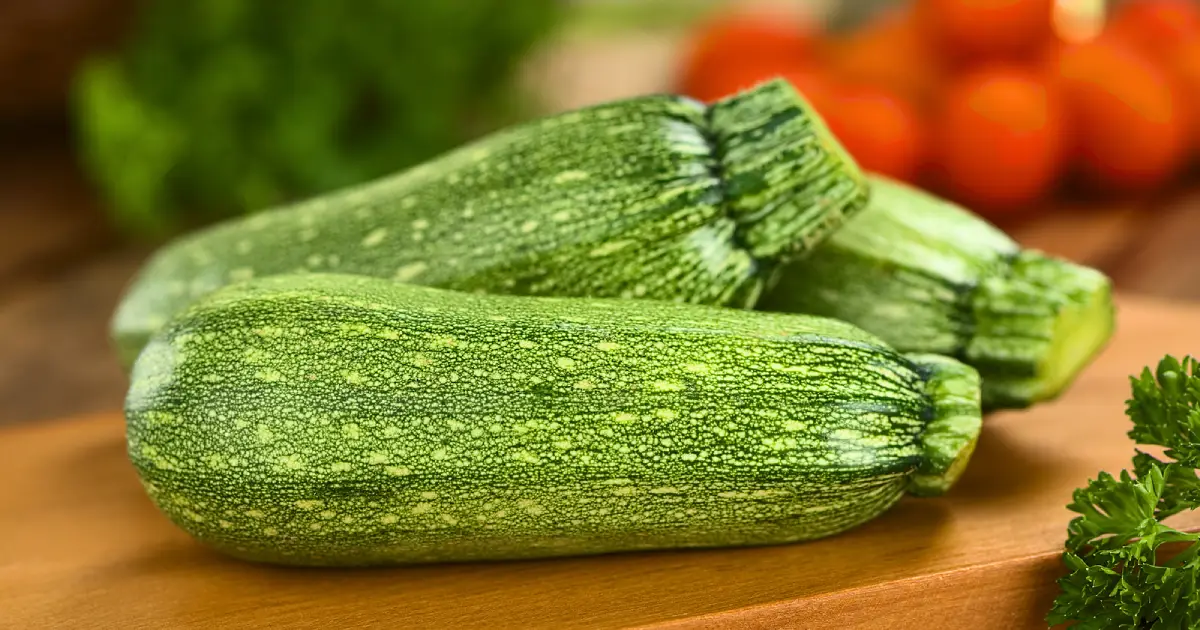
There is very little scientific research specific to zucchini, but let’s now go through what studies have found about the vegetable.
Suitability For Low-Potassium Diets
A 2025 randomized crossover trial investigated the potassium content of vegetables, including zucchini, after differing cooking methods.
Each of the vegetables used within the study was selected for being high in potassium (>201 mg per 100g).
While potassium is an essential nutrient with importance for human health, some individuals may be prescribed to follow medical low-potassium diets. Therefore, the study aimed to see how specific cooking techniques decreased potassium content.
The study found that pressure cooking zucchini resulted in the largest losses of potassium, with zucchini’s potassium content falling to 93.62 mg per 100 grams after being pressure cooked.
This shows that, despite being a moderate potassium source, zucchini may potentially fit into lower-potassium diets when pressure cooked.
However, it is just one study, and individuals following strict low-potassium diets should consult with their healthcare provider when assessing zucchini (or any other vegetable) intake.
Nutritionist’s Note: Cooking and Potassium Content
While the above study specifically relates to low-potassium diets, we can also look at it from the perspective of individuals trying to consume more potassium.
For example, for people on typical diets who are trying to increase their potassium intake, the study highlights how important the cooking method is; pressure cooking zucchini leads to high potassium losses.
This finding is supported by previous studies which showed potassium leaches into water during cooking.
In other words: If you wish to increase potassium intake, drier cooking methods, such as pan-frying and roasting, will preserve more of zucchini’s potassium.
Zucchini and Eye Health
A 2023 study presented an “ideal food pyramid” to either prevent or support eye-related health conditions.
These conditions included cataracts, macular degeneration, and diabetic retinopathy.
One of the main reasons zucchini was included in this food pyramid was for its lutein content. The authors noted that zucchini (cooked with skin) was among the vegetables with the highest lutein content, which they classed as >900 mg (milligrams) lutein per 100g.
Lutein is a carotenoid thought to support eye health. A 2021 systematic review of 46 studies found that higher intake of lutein and zeaxanthin increased macular pigment optical density (MPOD) when daily intake was over 5 mg (5,000 mcg).
MPOD is a marker of eye health, with higher levels thought to have a protective effect.
High Fiber Content Per Calorie
Zucchini contains 1 gram of fiber per 100 grams and 1.8 grams per 180-gram cup.
While this may not seem like a significant amount, zucchini is a notable fiber source compared to its total calorie and carbohydrate content.
For example, most people will have heard whole-wheat bread referred to as a good source of fiber.
The table below shows how much fiber per calorie cooked zucchini contains compared to whole-wheat bread:
Food
Fiber
Calories
Fiber per 100 calories
Cooked zucchini (100g)
1.0g
15 kcal
6.67g
Whole-wheat bread (100g)
6.0g
252 kcal
2.38g
Table 1: Fiber content per 100g and fiber per 100 calories: cooked zucchini compared to whole-wheat bread. Data source: USDA FoodData Central
As the table shows, zucchini has less total fiber, but it contains far higher amounts of fiber per 100 calories.
Zucchini is also significantly lower in carbohydrates than bread. This makes it a good fiber choice for individuals who are either limiting total calories or carbohydrates.
Zucchini Nutrition Facts
In the following tables you’ll see the full nutritional values for cooked courgette, presented both per 100 grams and per 180g cup (slices).
All nutritional data has been sourced from the USDA’s FoodData Central entry for cooked courgette. We have used this data alongside the FDA’s published daily values to calculate percent daily values (% DV) for each nutrient.
Calories and Macronutrients
Nutrient
Per 100g (% DV)
Per 180g cup (% DV)
Calories
15 kcal
27 kcal
Carbohydrates
2.69g (1%)
4.84g (2%)
Fiber
1.0g (4%)
1.8g (6%)
Sugars
1.71g
3.08g
Fat
0.36g (<1%)
0.65g (1%)
Saturated fat
0.07g (<1%)
0.13g (1%)
Monounsaturated fat
0.03g
0.05g
Polyunsaturated fat
0.15g
0.27g
Omega-3
0.09g
0.17g
Omega-6
0.06g
0.10g
Protein
1.14g (2%)
2.05g (4%)
Cholesterol
0 mg (0%)
0 mg (0%)
Table 2: Typical calorie and macronutrient content of cooked zucchini per 100g and 180g cup serving (slices)
Vitamins
Vitamin
Per 100g (% DV)
Per 180g cup (% DV)
Vitamin A (RAE)
56 mcg (6%)
101 mcg (11%)
Vitamin C
12.9 mg (14%)
23.2 mg (26%)
Vitamin D
0 mcg (0%)
0 mcg (0%)
Vitamin E
0.12 mg (1%)
0.22 mg (1%)
Vitamin K
4.2 mcg (4%)
7.56 mcg (6%)
Thiamin (B1)
0.04 mg (3%)
0.06 mg (5%)
Riboflavin (B2)
0.02 mg (2%)
0.04 mg (3%)
Niacin (B3)
0.51 mg (3%)
0.92 mg (6%)
Pantothenic acid (B5)
0.29 mg (6%)
0.52 mg (10%)
Vitamin B6
0.08 mg (5%)
0.14 mg (8%)
Folate (B9)
28 mcg (7%)
50.4 mcg (13%)
Vitamin B12
0 mcg (0%)
0 mcg (0%)
Choline
9.4 mg (2%)
16.9 mg (3%)
Table 3: Typical vitamin content of cooked zucchini per 100g and 180g cup serving (slices)
Minerals
Mineral
Per 100g (% DV)
Per 180g cup (% DV)
Calcium
18 mg (1%)
32.4 mg (2%)
Iron
0.37 mg (2%)
0.67 mg (4%)
Magnesium
19 mg (5%)
34.2 mg (8%)
Phosphorus
37 mg (3%)
66.6 mg (5%)
Potassium
264 mg (6%)
475 mg (10%)
Sodium
3 mg (<1%)
5.4 mg (<1%)
Zinc
0.33 mg (3%)
0.59 mg (5%)
Copper
0.05 mg (6%)
0.09 mg (10%)
Manganese
0.17 mg (7%)
0.31 mg (13%)
Selenium
0.2 mcg (<1%)
0.36 mcg (1%)
Table 4: Typical mineral content of cooked zucchini per 100g and 180g cup serving (slices)
Potential Drawbacks
Zucchini is a nutrient-rich vegetable that will be a positive addition to most diets.
That said, there is always the rare possibility of allergy, as there is for most foods. While zucchini allergies appear to be very uncommon, there have been documented case studies.
As stated, these issues appear to be very uncommon and there are only a few reported cases. However, if anyone feels they may have an issue with zucchini, they should consult with their healthcare provider for personalized guidance.
Summary
Zucchini provides a broad range of nutrients, most notably fiber, vitamin C, manganese, folate, potassium, and copper.
However, the most notable aspect of zucchini is that a typical 180g cup serving offers this range of nutrients for just 27 calories.
Overall, it’s a flavorful vegetable that pairs well with a wide range of foods, and it can contribute valuable essential nutrients to your diet.
References
Full List of Scientific References
(Click to Expand)
All citations used within this article are listed below, with full details for each scientific source.
USDA FoodData Central (2019). Squash, summer, zucchini, includes skin, cooked, boiled, drained, without salt. View USDA data
National Institutes of Health (NIH). (2025). Vitamin C: Fact sheet for consumers. View NIH information
National Institutes of Health (NIH). (2021). Manganese: Fact sheet for consumers. View NIH information
National Institutes of Health (NIH). (2021). Potassium: Fact sheet for consumers. View NIH information
Janete Catarina Martins Correa Haider et al. (2025). Potassium quantification and sensory analysis in plant food cooking processes in heart disease patients. View study in Clinical Nutrition ESPEN journal
P.C. Bethke and S.H. Jansky. (2008). The effects of boiling and leaching on the content of potassium and other minerals in potatoes. View study in the Journal of Food Science
Mariangela Rondanelli. (2023). Diet and ideal food pyramid to prevent or support the treatment of diabetic retinopathy, age-related macular degeneration, and cataracts. View study in Frontiers in Medicine journal
Lisa M Wilson et al. (2021). The effect of lutein/zeaxanthin intake on human macular pigment optical density: A systematic review and meta-analysis. View study in Advances in Nutrition journal
Michael works as a nutritionist in a community setting and holds a Master's degree in Clinical Nutrition. He is a Registered Associate Nutritionist (ANutr) with the Association for Nutrition (AfN), and has published peer-reviewed research.