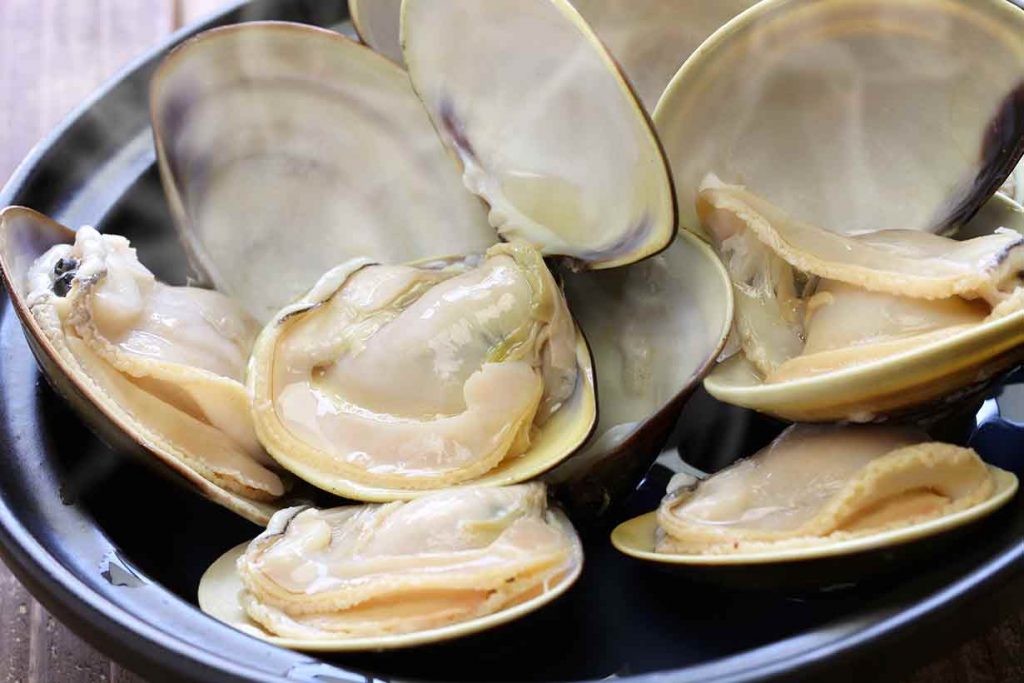
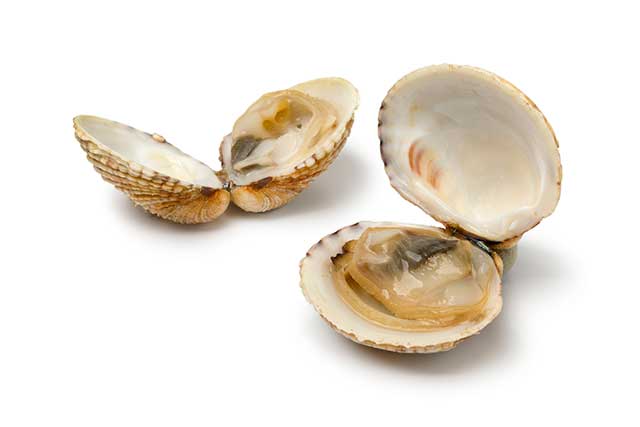
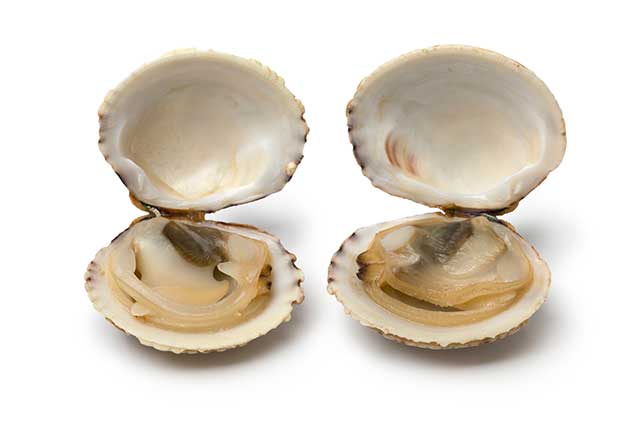
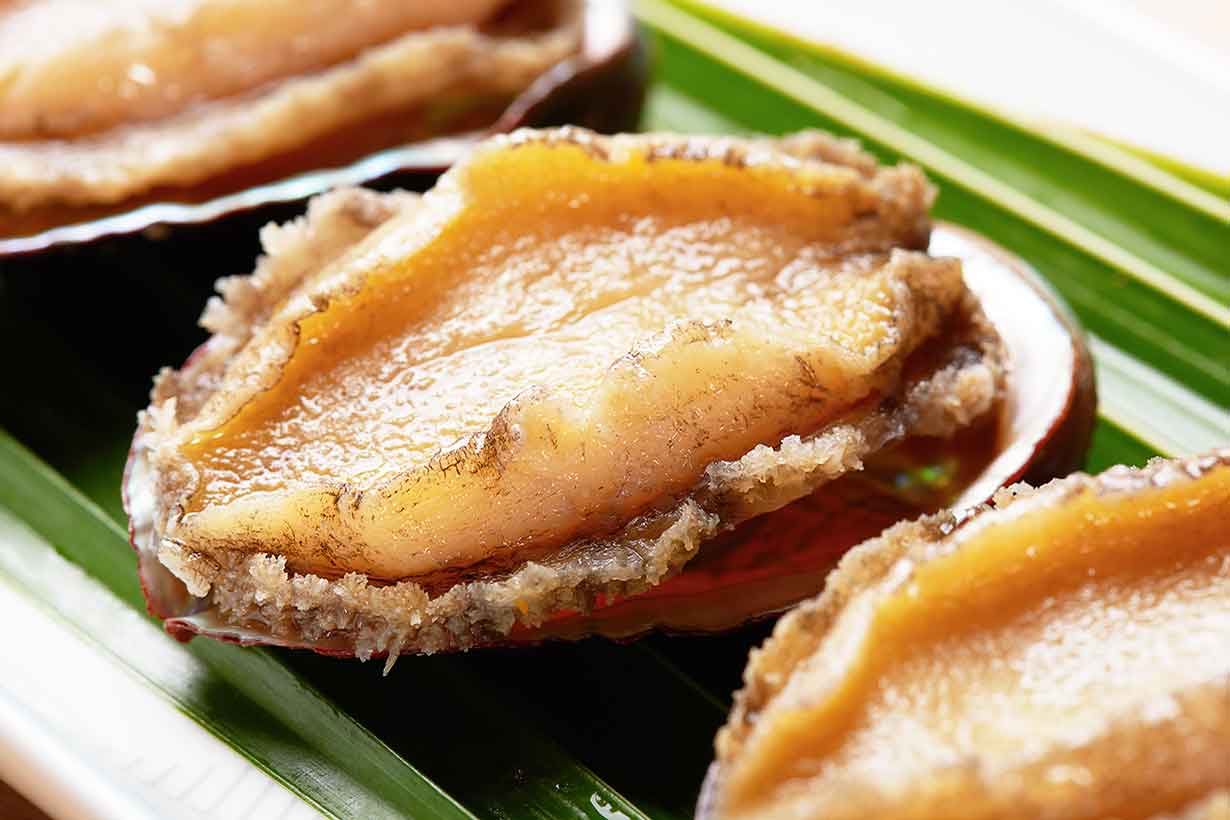
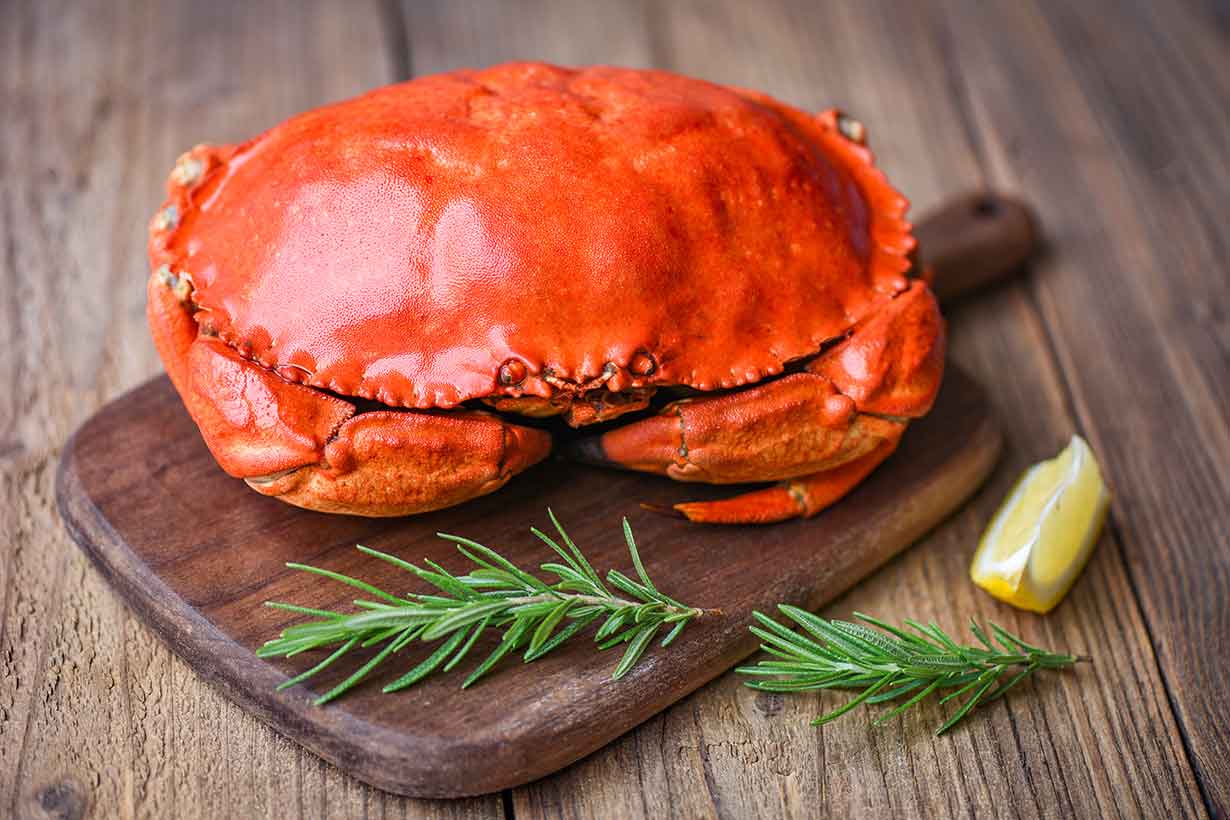
Before we start, let’s briefly examine precisely what clams are.
Firstly, they are known as a bivalve mollusk, which in plain English means a type of shellfish with a closing mechanism made of two shells held together by a hinge joint.
There are thousands of different species of clams around the world, with significant variations in size and shape. For example, the ‘giant clam’ can reach a height of four feet (122 cm) and weigh as much as 500 pounds (227 kg).
Taste
Clams have a mildly sweet and salty flavor.
Alongside this, they have a soft and chewy texture and are typically marinated with seasonings like garlic, lemon juice, butter or oil, and tomato-based sauces.
Key point: Clams are a bivalve mollusk, a type of shellfish similar to oysters and scallops.
Nutrition Profile
Before we look into the potential health effects of clams, let’s first examine their nutritional values.
The following tables present the calorie, macronutrient, vitamin, and mineral levels of clams. The values are based on USDA data for cooked clams, presented ‘per 100g’ and per 20 small clam (190g) serving.
Percent daily values (% DV) are based on a typical 2,000 calorie diet.
Calories and Macronutrients
Nutrient
Per 100g (% DV)
Per 20 small clams (190g) (% DV)
Calories
148 kcal
281 kcal
Carbohydrates
5.13g (2%)
9.75g (4%)
Fiber
0g (0%)
0g (0%)
Sugars
—
—
Fat
1.95g (3%)
3.7g (5%)
Saturated fat
0.19g (1%)
0.36g (2%)
Monounsaturated fat
0.17g
0.33g
Polyunsaturated fat
0.55g
1.05g
Omega-3
0.43g
0.81g
(EPA + DHA)
0.28g
0.54g
Omega-6
0.11g
0.22g
Protein
25.6g (51%)
48.6g (97%)
Cholesterol
67 mg (22%)
127 mg (42%)
Table 1: Calories and macronutrient content of cooked clams per 100g and per 20 small clams (190g)
As you can see, clams contain high levels of protein and a moderate amount of omega-3.
With 100 grams of cooked clams providing 25.6 grams of protein for only 148 calories, they are a lean protein source.
Vitamins
Vitamin
Per 100g (% DV)
Per 20 small clams (190g) (% DV)
Vitamin A (RAE)
171 mcg (19%)
325 mcg (36%)
Vitamin C
22.1 mg (25%)
42 mg (47%)
Vitamin D
—
—
Vitamin E
—
—
Vitamin K
—
—
Thiamin (B1)
0.15 mg (13%)
0.29 mg (24%)
Riboflavin (B2)
0.43 mg (33%)
0.81 mg (62%)
Niacin (B3)
3.35 mg (21%)
6.36 mg (40%)
Pantothenic acid (B5)
0.68 mg (14%)
1.29 mg (26%)
Vitamin B6
0.11 mg (6%)
0.21 mg (12%)
Folate (B9)
29 mcg (7%)
55.1 mcg (14%)
Vitamin B12
98.9 mcg (4121%)
188 mcg (7833%)
Choline
—
—
Table 2: Vitamin content of cooked clams per 100g and per 20 small clams (190g)
The standout vitamin in clams is vitamin B12, with few foods offering higher levels.
Per typical serving, clams are also high in vitamins A and C, thiamin, riboflavin, niacin, and pantothenic acid, providing more than 20% of the daily value for each.
Minerals
Mineral
Per 100g (% DV)
Per 20 small clams (190g) (% DV)
Calcium
92 mg (7%)
175 mg (13%)
Iron
2.81 mg (16%)
5.34 mg (30%)
Magnesium
18 mg (4%)
34.2 mg (8%)
Phosphorus
338 mg (27%)
642 mg (51%)
Potassium
628 mg (13%)
1190 mg (25%)
Sodium
1200 mg (52%)
2280 mg (99%)
Zinc
2.73 mg (25%)
5.19 mg (47%)
Copper
0.69 mg (77%)
1.31 mg (146%)
Manganese
1 mg (43%)
1.9 mg (83%)
Selenium
64 mcg (116%)
122 mcg (222%)
Table 3: Mineral content of cooked clams per 100g and per 20 small clams (190g)
Clams provide a broad range of minerals in high concentrations, particularly copper and selenium. Per typical serving, they are also high in iron, phosphorus, potassium, sodium, zinc, and manganese.
Nutritionist’s Note
Nutrient-rich: Clams are a food that provide a way to obtain many different nutrients in high amounts.
Sodium content: A typical serving of clams can provide nearly 100% of the daily value for sodium, depending on the specific clam and cooking method. Individuals following a low-sodium diet should consult their healthcare provider.
Potential Health Benefits
There is little scientific research specific to the health effects of clams.
However, based on their nutritional profile, here is an overview of some of the potential benefits that clams may offer.
High in Vitamin B12
Clams are a rich source of vitamin B12, with USDA data showing that 20 small cooked clams (190g) provide 188 mcg of the vitamin. This is equal to many multiples of the daily value (% DV) for vitamin B12, which is only 2.4 mcg.
Since clams are such a concentrated source, only a small amount is necessary to provide sufficient vitamin B12.
This is an important fact to remember because a lot of people only associate meat (especially red meat) with B12. The truth is that many kinds of seafood are high in vitamin B12, with clams providing a significant amount.
The optimal function of the central nervous system
Key point: Clams provide a high amount of vitamin B12, an essential nutrient found in animal-based foods.
Provides EPA and DHA Omega-3
Oily fish such as mackerel, salmon, and sardines are arguably the best dietary sources of omega-3.
While shellfish offer a comparatively smaller amount of this essential fatty acid, they still contribute a moderate amount of EPA (eicosapentaenoic acid) and DHA (docosahexaenoic acid).
20 small cooked clams (190g) offer 0.54 grams of EPA and DHA according to USDA data, with these two fatty acids being the most bioactive forms of omega-3.
Research suggests that higher intakes of EPA and DHA can raise the omega-3 index, which refers to the proportion of EPA and DHA in red blood cells. Notably, a higher omega-3 index of >8% has been associated with a lower risk of cardiac-related death.
Key point: Clams offer a moderate amount of bioactive EPA and DHA omega-3 fatty acids. However, oily fish remain the most significant dietary source.
Clams Provide a Good Source of Iron
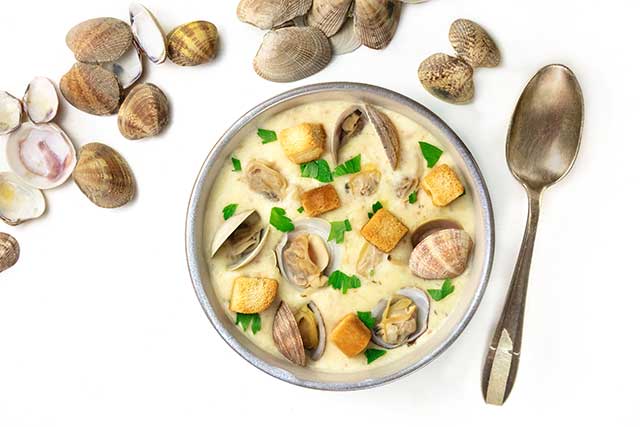
A bowl of clam chowder
Offering more than 30% of the daily value for iron per 20-clam (190g) serving, clams are a rich source of this essential mineral.
Ensuring a sufficient iron intake is also crucial for the prevention of deficiency, with iron-deficiency having a high global prevalence. For instance, a large 2024 observational study estimated that iron deficiency may affect as much as 14% of the United States population.
Key point: With more than 30% of the daily value per typical serving, clams can help contribute to iron sufficiency.
A Rare Non-Plant Source of Vitamin C
While many people think that vitamin C only comes from fruit, there are a wide variety of foods that provide it.
For instance, leafy green vegetables tend to contain more of the vitamin than most fruit.
However, some animal foods can also be a good source of vitamin C.
A serving of 20 small clams (190g) provides nearly half (47%) of the daily value for vitamin C.
Key point: Clams are among the relatively few animal-based foods that contain a significant amount of vitamin C.
Rich In Iodine and Selenium
Clams provide high amounts of the minerals iodine and selenium:
According to the database managed by the USDA, FDA, and Office of Dietary Supplements within the National Institutes of Health, clams provide 66 mcg of iodine per 100 grams. This is 44% of the daily value.
USDA data shows that a cooked 20-clam (190g) serving provides 122 mcg of selenium— 220% of the daily value.
An essential mineral, iodine has many important functions, being particularly important for brain and skeletal development, especially during pregnancy and infanthood.
Selenium is an essential mineral with a key role in protecting human health through its role in supporting enzymes involved in the antioxidant system.
Key point: Clams are a good dietary choice for contributing toward iodine and selenium sufficiency.
Potential Health Risks and Side Effects
There is no need for alarm, and clams are an otherwise healthy, nutrient-rich food. That said, there are a few potential health risks to understand about them.
This primarily revolves around potential allergies, heavy metal content, and foodborne illnesses.
Since allergic reactions can potentially be severe, it is important to be cautious. For this reason, anyone with any kind of shellfish allergy should consult their healthcare provider before consuming clams.
Key point: While not as common as allergies to crustacean shellfish like shrimp, some people are allergic to clams.
Shellfish poisoning is often caused by algae-like bacteria called dinoflagellates. The bacteria can survive the cooking process, so cooking clams won’t prevent poisoning.
The National Institutes of Health advises that shellfish poisoning can sometimes be a medical emergency, and that emergency treatment should be sought if experiencing “sudden or severe” symptoms.
A disease called vibriosis can also be contracted through clam consumption. This can be due to consuming clams from coastal waters containing Vibrio bacteria. While relatively rare, vibriosis can potentially lead to severe symptoms.
Anyone who suspects they have contracted any kind of foodborne illness from clams should consult their healthcare provider.
Key point: Consuming clams can occasionally lead to food poisoning, but cooking them properly can help reduce some of these risks.
Do Clams Contain Mercury?
According to the FDA’s mercury monitoring program, which ran from 1990–2012, clams typically contain an extremely low concentration of mercury.
The data collected as part of this program indicates that clams contain significantly lower mercury levels than popular seafood products like salmon, cod, haddock, sardines, mackerel, and tuna.
Summary
Clams have a good nutritional profile and provide high levels of protein and several key vitamins and minerals.
While shellfish poisoning is an uncommon risk, the risk can be reduced by cooking them properly and buying from reputable sellers.
Michael works as a nutritionist in a community setting and holds a Master's degree in Clinical Nutrition. He is a Registered Associate Nutritionist (ANutr) with the Association for Nutrition (AfN), and has published peer-reviewed research.