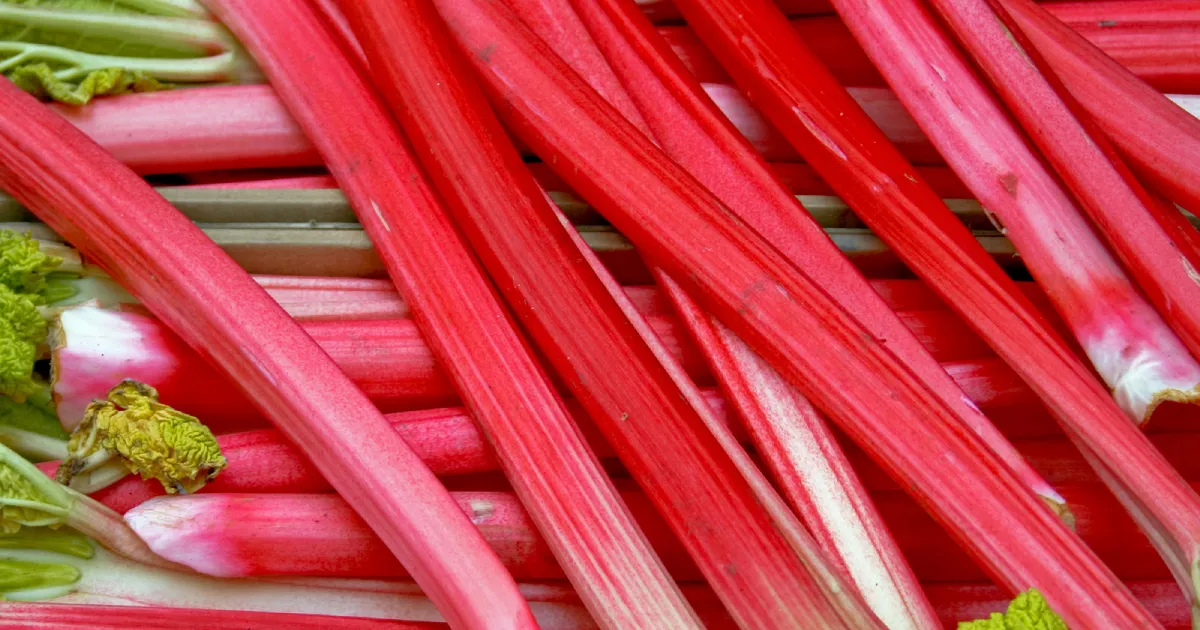
Rhubarb refers to the edible stalks of the rhubarb plant, which is known scientifically as Rheum rhabarbarum.
In this evidence-based guide, we examine rhubarb’s key nutrients, its potential benefits and drawbacks, and what recent scientific research shows.
While rhubarb is botanically a vegetable, it is widely used as a fruit in a culinary sense, and it is a notable source of fiber, calcium, and vitamin K. However, not all of these nutrients in rhubarb are easy to absorb, which we will explain in detail.
Data source note: We typically use USDA data for our nutritional values, but the USDA only has cooked rhubarb data for ‘sweetened’ rhubarb. Looking at the nutritional data, this likely involves large amounts of added sugar and isn’t an accurate portrayal of the nutrient profile of pure rhubarb. For enhanced accuracy, we therefore chose to source our rhubarb nutritional data from the NCC Food and Nutrient Database’s entry for cooked, unsweetened rhubarb.
A 240g cup of cooked, unsweetened rhubarb contains 34 calories and provides notable amounts of the following nutrients:
Carbohydrates: 6.0g
Fiber: 3.12g
Vitamin K: 53% of the daily value (% DV)
Calcium: 36% DV
Manganese: 19% DV
Vitamin C: 13% DV
Potassium: 13% DV
Magnesium: 10% DV
Fiber
With 3.12 grams of fiber, a 240g cup of cooked rhubarb provides 11% of the daily value for fiber.
Rhubarb contains both soluble and insoluble fiber, with soluble fiber helping to slow digestion and feed the microbiota (beneficial bacterial microbes in the gut). In contrast, insoluble fiber may help to improve regularity as it adds bulk to stools, potentially reducing the risk of constipation.
Vitamin K
Based on absolute concentration, the most notable nutrient in rhubarb is vitamin K, which is present in the form of phylloquinone (vitamin K1).
A cup serving provides 63.84 mcg, which is 53% of the daily value.
Vitamin K plays an important role in bone health. According to the results of a 2022 systematic review, vitamin K was associated with a decreased fracture risk.
Calcium
Calcium is also an essential mineral that has key functions for bone health. A cup serving of cooked rhubarb provides 466 mg of calcium, which is equal to 36% of the daily value.
However, because rhubarb contains a significant amount of oxalic acid (oxalate), only a small amount of this calcium is bioavailable. This is because oxalate binds calcium, meaning that our body cannot use most of the calcium present in rhubarb.
In short, this means that while rhubarb is technically high in calcium, it is a poor dietary source of the mineral. Other than calcium and vitamin K, a cup of rhubarb is not high (>20% DV) in other essential nutrients.
Potential Health Benefits and Scientific Research
There is limited high-quality research on rhubarb in the form of clinical trials involving human participants. While there is a lot of research on rhubarb roots and extracts of them, there is little on the actual rhubarb stalks that people eat.
However, some studies have found rhubarb may have potential benefits in specific contexts.
In the following section, you can see an overview of these research findings, what they mean, and their limitations:
However, there was only a limited number of studies and participants this was tested in, and more extensive research is necessary to confirm this.
Without further confirmatory research in this area, we should be cautious about the results. However, it is possible that rhubarb consumption may lower LDL-C through its soluble fiber content.
In this regard, a 2023 systematic review of randomized controlled trials found a dose-response association between soluble fiber intake and reductions in LDL-C. These results showed that each daily 5-gram increase in soluble fiber had a significant impact on lowering LDL-C.
That said, NCC data suggests a 240-gram cup of cooked rhubarb contains only around 1.10 grams of soluble fiber.
Based on this, rhubarb can contribute to total daily soluble fiber intake, but it doesn’t provide a significant amount on its own.
Nutritionist’s Note
It is worth noting that rhubarb contains bioactive compounds, also known as phytonutrients (plant chemicals), that may have an impact on cholesterol.
These compounds include emodin, which is considered a major bioactive in rhubarb.
A systematic review of preclinical trials found that emodin significantly lowered LDL-C levels in animal studies, so there is a mechanism for this. However, animal studies are weak evidence for predicting an effect in humans, and such results require confirmation from human studies.
Furthermore, the doses of emodin used in these trials were significantly higher than the amount of emodin you’d get from a realistic serving of rhubarb stalks. This means that any positive effects from emodin in rhubarb are likely to be insignificant.
Potential Drawbacks
There are two major potential drawbacks to consider regarding rhubarb, and these include the high sugar content of typical rhubarb recipes and its high oxalate levels.
Rhubarb is Typically High in Added Sugars
Rhubarb has an extremely sour, tart flavor, primarily due to the high concentrations of malic acid it contains. For this reason, most people add sugar for sweetness as they cook and mash rhubarb, meaning it can be a significant source of added sugar.
To show just how much sugar can be added to rhubarb, the NCC database shows the following sugar content for both sweetened and unsweetened rhubarb:
In contrast, low-oxalate diets are typically described as containing less than 50–100 mg oxalate per day.
While it is okay for most people to eat a typical serving of foods high in oxalate, this compound, also known as oxalic acid, can potentially have some negative effects:
Binding calcium: Oxalate binds to calcium, creating calcium oxalate crystals. This significantly reduces the bioavailability of calcium in rhubarb or calcium consumed alongside rhubarb.
Calcium oxalate kidney stones: Calcium oxalate crystals may raise the risk of kidney stones in people prone to developing them. For this reason, some people prone to kidney stones are advised to follow a low-oxalate diet.
Nutritionist’s Note
Rhubarb being high in oxalate doesn’t mean it is “bad” for you. However, if you are trying to obtain more calcium from your diet, then it may be a net negative addition.
Due to its oxalate content, rhubarb is not suitable for individuals who have been prescribed a low-oxalate diet. Individuals should consult their healthcare provider if they have any questions about this.
Full Nutrition Profile
Now that we know a bit more about rhubarb’s key nutrients and potential benefits and drawbacks, let’s examine its full nutritional values.
Based on nutritional data from the NCC Food and Nutrient database, the following tables show the complete nutritional profile of unsweetened, cooked rhubarb both per 240g cup and per 100g.
Nutrient
Per 100g (% DV)
Per 240g cup (% DV)
Calories
14 kcal
34 kcal
Carbohydrates
2.50g (<1%)
6.00g (<1%)
Fiber
1.30g (5%)
3.12g (11%)
Sugars
1.20g
2.88g
Fat
0.60g (1%)
1.44g (2%)
Saturated fat
—
—
Monounsaturated fat
—
—
Polyunsaturated fat
—
—
Omega-3
—
—
Omega-6
—
—
Protein
1.00g (2%)
2.40g (5%)
Cholesterol
0 mg (0%)
0 mg (0%)
Table 1: Typical calorie and macronutrient content of cooked, unsweetened rhubarb per 100g and per 240g cup serving
Vitamins
Vitamin
Per 100g (% DV)
Per 240g cup (% DV)
Vitamin A (RAE)
5.33 mcg (<1%)
12.80 mcg (1%)
Vitamin C
5.0 mg (6%)
12 mg (13%)
Vitamin D
0 mcg (0%)
0 mcg (0%)
Vitamin E
0.18 mg (1%)
0.43 mg (3%)
Vitamin K
26.6 mcg (22%)
63.84 mcg (53%)
Thiamin (B1)
0.03 mg (3%)
0.07 mg (6%)
Riboflavin (B2)
0.02 mg (2%)
0.05 mg (4%)
Niacin (B3)
0.20 mg (1%)
0.48 mg (3%)
Pantothenic acid (B5)
0.08 mg (2%)
0.19 mg (4%)
Vitamin B6
0.02 mg (1%)
0.05 mg (3%)
Folate (B9)
8.00 mcg (2%)
19.20 mcg (5%)
Vitamin B12
0 mcg (0%)
0 mcg (0%)
Choline
7.90 mg (1%)
18.96 mg (3%)
Table 2: Typical vitamin content of cooked, unsweetened rhubarb per 100g and per 240g cup serving
As the table shows, a cup of cooked rhubarb is high in vitamin K and also provides a notable amount of vitamin C.
Minerals
Mineral
Per 100g
Per 240g cup
Calcium
194 mg (15%)
466 mg (36%)
Iron
0.29 mg (2%)
0.70 mg (4%)
Magnesium
18 mg (4%)
43.20 mg (10%)
Phosphorus
26 mg (2%)
62.40 mg (5%)
Potassium
261 mg (6%)
626.39 mg (13%)
Sodium
1 mg (<1%)
2.40 mg (<1%)
Zinc
0.11 mg (1%)
0.26 mg (2%)
Copper
0.04 mg (4%)
0.10 mg (11%)
Manganese
0.18 mg (8%)
0.43 mg (19%)
Selenium
0.40 mcg (<1%)
0.96 mcg (2%)
Table 3: Typical mineral content of cooked, unsweetened rhubarb per 100g and per 240g cup serving
With over 20% of the daily value for calcium, a cup of cooked rhubarb is technically high in calcium. However, as mentioned previously, rhubarb is not a good dietary source of calcium due to its oxalate content.
A cup of rhubarb also offers notable amounts of copper, magnesium, manganese, and potassium.
Rhubarb in a Nutshell
Overall, rhubarb provides a good range of nutrients, including high levels of vitamin K and moderate amounts of copper, fiber, magnesium, manganese, and potassium.
For those who enjoy the flavor of rhubarb, it can play a role in a healthy diet. However, its calcium content shouldn’t be a reason for its consumption, since the amount of bioavailable calcium it provides is low.
Additionally, using large amounts of added sugar in rhubarb-based recipes may push it from being a healthy dietary addition to one to limit.
References
Full List of Scientific References
(Click to Expand)
All citations used within this article are listed below, with full details for each scientific source.
University of Minnesota Nutrition Coordinating Center (NCC) (n.d.). Database Licensing. View information
Salma et al. (2022). Effect of vitamin K on bone mineral density and fracture risk in adults: Systematic review and meta-analysis. View study in Biomedicines journal
Blerina Shkembi and Thom Huppertz. (2021). Calcium absorption from food products: Food Matrix Effects. View study in Nutrients journal
Abed Ghavami et al. (2023). Soluble fiber supplementation and serum lipid profile: A systematic review and dose-response meta-analysis of randomized controlled trials. View study in Advances in Nutrition journal
Boyang Hu et al. (2014). Aloe-emodin from rhubarb (Rheum rhabarbarum) inhibits lipopolysaccharide-induced inflammatory responses in RAW264.7 macrophages. View study in the Journal of Ethnopharmacology
Yang Xiao et al. (2025). Emodin, a rising star in the treatment of glycolipid metabolism disorders: A preclinical systematic review and meta-analysis. View study in PeerJ journal
U.S. Department of Agriculture (USDA) and the U.S. Department of Health and Human Services (HHS). (2026). Dietary Guidelines for Americans, 2025–2030. View Dietary Guidelines for Americans, 2025–2030
Neuza Salgado et al. (2023). Oxalate in foods: Extraction conditions, analytical methods, occurrence, and health implications. View study at PubMed
Michael works as a nutritionist in a community setting and holds a Master's degree in Clinical Nutrition. He is a Registered Associate Nutritionist (ANutr) with the Association for Nutrition (AfN), and has published peer-reviewed research.