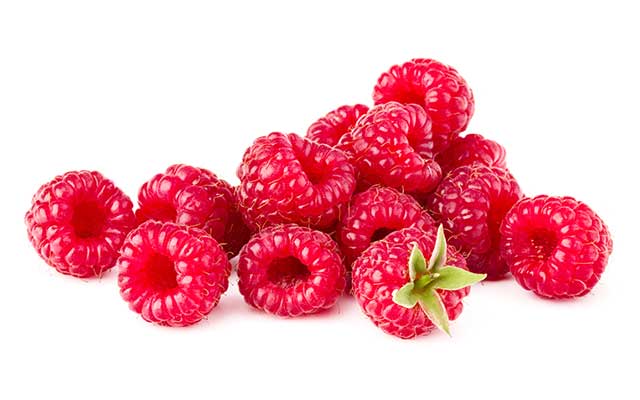
In this article, we’ll focus on red raspberries, looking at their potential health benefits according to recent scientific research.
We’ll also examine their full nutritional profile, so that you know which essential nutrients and bioactive compounds (such as polyphenols) they provide.
In the following sections, we’ll examine some of the potential health benefits of red raspberries, based on findings from recent studies.
May Support Heart Health
Some studies suggest that raspberry consumption may benefit vascular function, the health of blood vessels in the heart and other areas of the body.
For example, a 2018 randomized controlled trial found that “dietary achievable amounts of red raspberries” led to substantial improvements in endothelial function. Endothelial function is a term describing the health of the lining (endothelium) of the arteries and veins.
In the study, participants exhibited “significant improvement in flow-mediated dilation (FMD)” two hours, and up to 24 hours, following 200 grams of raspberry intake. The researchers concluded that raspberry polyphenols, specifically ellagitannins, may be responsible for this effect.
While this improvement in vascular function is promising, there is also evidence to suggest that raspberries may improve traditional markers of heart health.
For example, a 2024 systematic review of 13 trials found that raspberry intake led to significant reductions in “bad” LDL cholesterol. However, this effect was only seen in studies longer than eight weeks, and was observed in individuals older than 35 with metabolic syndrome or with health conditions like overweight or high cholesterol.
For anyone unaware, let me quickly explain what ‘oxidative stress’ and ‘free radicals’ are.
Firstly, free radicals are unstable molecules that can potentially damage DNA and cells within the body. We can’t “escape” free radicals, as even normal metabolic processes (such as digesting food) can generate them. However, larger amounts can be generated from exposure to enviromental pollution, lack of sleep, smoking, and other lifestyle factors.
When our body doesn’t have sufficient resources to deal with these free radicals, it experiences something called ‘oxidative stress.’
Vitamin C has antioxidant properties, which means that it can help to stabilize these free radicals and stop them from causing damage. It can also help repair damage caused by free radicals.
High Fiber Content Supports Digestive Health
If you’re looking to increase your fiber intake, red raspberries are among the best choices.
According to USDA data, a single cup of raspberries (123g) provides 8.0 grams of fiber, which is nearly 30% of the daily value.
As well as being high in fiber, raspberries are also among the most fiber-dense foods. This means they have a very high fiber content relative to their total energy (caloric) density. A cup serving contains 8 grams of fiber yet only 64 calories.
Higher dietary fiber intake can have a range of benefits, including
Blood sugar: Fiber can slow digestion, leading to lower spikes in blood sugar after carbohydrate-containing meals.
Binding ability: Fiber has the ability to bind to carcinogens in the digestive tract, potentially lowering their interaction with digestive cells. It then eliminates them through the stool, likely lowering the total time they spend in the digestive tract.
Better long-term health: Higher fiber intake is consistently associated with lower all-cause mortality in large, systematic reviews.
There are many fruits high in fiber, but not many match the amount raspberries provide.
Potential Blood Sugar Benefits
A 2019 randomized controlled trial examined the effect of red raspberries on post-meal blood sugar levels in individuals at risk of developing diabetes.
In this study, participants consumed a high-carbohydrate, moderate-fat breakfast meal alongside either:
0g raspberries
250g raspberries
125g raspberries
Notably, eating additional raspberries alongside the meal lowered post-meal blood sugar and insulin levels compared to control (no raspberries).
Another randomized controlled trial published in 2019 investigated the impact of raspberry intake on blood sugar levels.
In the study, participants were given either raspberries or a calorie and carbohydrate-matched control food (banana). The study found that eating raspberries resulted in significantly lower blood sugar levels two and four hours post-meal compared to control.
Nutritionist’s Note
This is an important finding that should remind us that it isn’t just total carbohydrate that raises blood sugar – it’s the overall composition of the food.
It is better to avoid mantra such as “carbs are carbs” and instead focus on what could be called “carb quality.”
For instance, total carbohydrate being equal, raspberries are likely to have a lower impact on blood sugar than bananas. This is likely to be primarily due to their higher fiber and lower sugar content, but other compounds in the berries may also contribute. Equally, bananas would have a lesser effect on blood sugar compared to candy.
High in Polyphenols
Similar to other berries, raspberries contain high concentrations of polyphenols, which are bioactive compounds found in plants. Raspberries are high in specific classes of these compounds called anthocyanins, ellagic acid, and ellagitannins.
Anthocyanins are some of the most well-researched polyphenols:
According to a 2025 systematic review, anthocyanins may potentially benefit human health in numerous areas. Specifically, the review found evidence for anthocyanins having anti-inflammatory effects as well as potentially improving lipid (cholesterol) profiles and lowering cardiovascular risk.
A 2019 systematic review found that anthocyanin supplementation over 300 mg per day significantly lowered total cholesterol and “bad” LDL cholesterol.
Regarding ellagitannins, a 2022 systematic review found that ellagitannin-rich fruit intake was associated with lower blood pressure. However, this effect was seen at doses between 500–1,000 mg per day.
Nutritionist’s Note
If you’re wondering how much raspberry you need to eat for 300 mg of anthocyanins, it’s approximately 400 grams of fresh raspberries. This is based on red raspberries containing, on average, around 75 mg of anthocyanins per 100g.
However, for ellagitannins, raspberries contain slightly more than 100 mg per day. This data is available from Phenol-Explorer, recognized as being the most comprehensive database on the polyphenol content of food.
While these polyphenol doses associated with health benefits are possible with raspberry intake, they would be very large serving sizes. A typical cup of raspberries weighs 123g, so we’d be looking at more than three cups.
The primary mineral that raspberries provide in high amounts if manganese, with a cup containing around 0.82 mg – about 36% of the daily value.
Manganese has numerous functions in the body, and it is involved in processes that support bone health, wound healing, and metabolism.
The mineral is quite prevalent in food, but raspberries still provide a significant amount.
May Improve Gut Health
A 2022 randomized controlled trial involving twenty-six adults with prediabetes found that four weeks of daily red raspberry intake (125g) positively impacted gut health.
Specifically, the results included:
Gut microbiota changes: the presence of “good” bacteria (Eubacterium eligens) doubled. At the same time, bacteria deemed “bad” (Rumnococcus gnavus) decreased by 60%.
Positive impact on health markers: The study also found that LDL-C decreased by 7.2% and participants experienced improvements in insulin sensitivity.
Research on the microbiota (gut bacteria) is in the early stages. However, a higher prevalence of Eubacterium eligens is thought to potentially have health-protective properties.
Research suggests this may be due to its potential to lower cholesterol and reduce gut inflammation.
Nutritional Profile
The following nutrition tables show the complete nutritional profile of red raspberries per 100g and per 123-gram cup serving. The source of nutritional data is the USDA’s FoodData Central database .
The USDA’s FoodData Central is the source of nutritional data. We have calculated percent daily values (% DV) from this data, which are based on a typical 2,000 calorie diet.
Calories and Macronutrients
Nutrient
Per 100g (% DV)
Per 123g cup (% DV)
Calories
52 kcal
64 kcal
Carbohydrates
11.9g (4%)
14.6g (5%)
Fiber
6.5g (23%)
8.0g (29%)
Sugars
4.42g
5.44g
Fat
0.65g (1%)
0.80g (1%)
Saturated
0.02g (<1%)
0.02g (<1%)
Monounsaturated
0.06g
0.08g
Polyunsaturated
0.38g
0.46g
Omega-3
0.13g
0.16g
Omega-6
0.25g
0.31g
Protein
1.2g (2%)
1.48g (3%)
Cholesterol
0 mg (0%)
0 mg (0%)
Table 1: Calorie and macronutrient content of red raspberries per 100g and per 123g cup
As the data shows, red raspberries are high in fiber despite only containing a modest amount of calories and carbohydrates.
They are not a significant source of fat or protein.
Vitamins
Vitamin
Per 100g (% DV)
Per 123g cup (% DV)
Vitamin A (RAE)
2 mcg (<1%)
2.46 mcg (<1%)
Vitamin C
26.2 mg (29%)
32.2 mg (36%)
Vitamin D
0 mcg (0%)
0 mcg (0%)
Vitamin E
0.87 mg (6%)
1.07 mg (7%)
Vitamin K
7.8 mcg (7%)
9.59 mcg (8%)
Thiamin (B1)
0.03 mg (3%)
0.04 mg (3%)
Riboflavin (B2)
0.04 mg (3%)
0.05 mg (4%)
Niacin (B3)
0.60 mg (4%)
0.74 mg (5%)
Pantothenic acid (B5)
0.33 mg (7%)
0.41 mg (8%)
Vitamin B6
0.06 mg (4%)
0.07 mg (4%)
Folate (B9)
21 mcg (5%)
25.8 mcg (6%)
Vitamin B12
0 mcg (0%)
0 mcg (0%)
Choline
12.3 mg (2%)
15.1 mg (3%)
Table 2: Vitamin content of red raspberries per 100g and per 123g cup
Raspberries offer a high amount of vitamin C and a small to moderate provision of other essential vitamins.
Minerals
Mineral
Per 100g (% DV)
Per 123g cup (% DV)
Calcium
25 mg (2%)
30.8 mg (2%)
Iron
0.69 mg (4%)
0.85 mg (5%)
Magnesium
22 mg (5%)
27.1 mg (6%)
Phosphorus
29 mg (2%)
35.7 mg (3%)
Potassium
151 mg (3%)
186 mg (4%)
Sodium
1 mg (<1%)
1.23 mg (<1%)
Zinc
0.42 mg (4%)
0.52 mg (5%)
Copper
0.09 mg (10%)
0.11 mg (12%)
Manganese
0.67 mg (29%)
0.82 mg (36%)
Selenium
0.2 mcg (<1%)
0.25 mcg (<1%)
Table 3: Mineral content of red raspberries per 100g and per 123g cup
Red raspberries contain high levels of manganese and they’re a moderate source of copper. They also contain most other essential minerals but in small amounts.
Fresh vs. Frozen Red Raspberries
You may have noticed in the supermarket that frozen raspberries tend to be quite a bit cheaper than fresh raspberries.
While both have their own uses, frozen raspberries offer greater affordability and longer storage. But do they offer the same nutrient composition and potential health benefits?
The good news: Research has looked into this, with one study investigating and comparing the nutritional composition of fresh and frozen red raspberries.
Further good news is that there were no significant differences between the two:
Before freezing: Researchers tested the vitamin and bioactive compounds in fresh raspberries and then froze them.
After freezing: Assessing the composition of the frozen berries several days later, there were no significant changes in vitamin C and polyphenol content.
In their conclusion, the researchers noted that fresh and frozen raspberries contain similar levels of polyphenols and vitamin C.
The takeaway here is that both fresh and frozen raspberries are great choices, so go with whichever is the best option for you.
Summary
Red raspberries are a high-fiber, vitamin C-rich fruit that contain significant amounts of polyphenols.
The berries have several potential health benefits and make a great addition to most diets.
Michael works as a nutritionist in a community setting and holds a Master's degree in Clinical Nutrition. He is a Registered Associate Nutritionist (ANutr) with the Association for Nutrition (AfN), and has published peer-reviewed research.