Sweet corn is commonly consumed as a vegetable and it is the fresh form of the corn grain.
Based on USDA data published in 2025, sweet corn is in the top two crops grown in the United States by harvest area, along with tomatoes.
From its high provision of folate, carotenoids, and ferulic acid, this article helps you understand more about sweet corn’s potential nutritional benefits and drawbacks.
Using reputable nutritional data and recent scientific research findings, let’s find out what sweet corn offers.
Table of contents
Potential Benefits
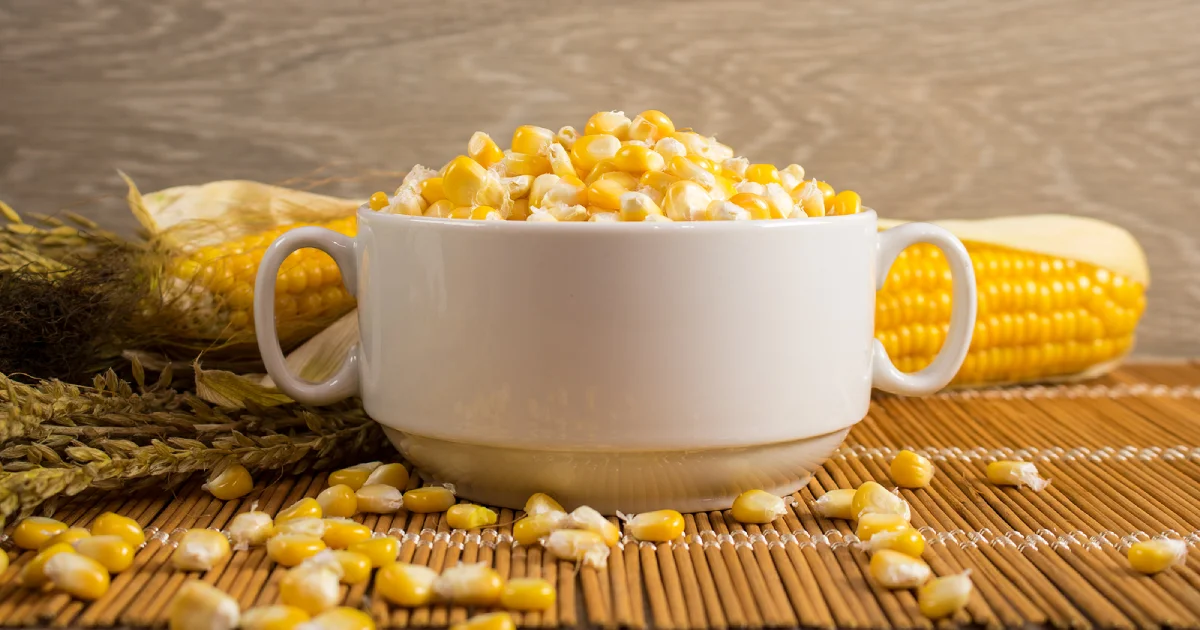
First, let’s explore some of the potential benefits that sweet corn may provide.
Sweet Corn is a Rich Source of Folate
A 164g cup of canned sweet corn typically contains 64 mcg of folate, which is 16% of the daily value.
Among its functions, folate is a key essential vitamin (also known as vitamin B9) for supporting healthy pregnancies.
Additionally, a 2023 systematic review of 24 large observational studies investigated the impact of folate intake on colorectal cancer risk in 6,165,894 participants.
The review found that high compared to low folate intake was associated with a 12% reduced relative risk of colorectal cancer.
Contains Phytochemicals With Potential Health Benefits
Sweet corn is a rich source of phytochemicals, including:
- Alkaloids
- Carotenoids
- Flavonoids
- Phenolic acids
The individual phytochemicals within these categories include zeaxanthin, beta-carotene, and lutein (carotenoids), anthocyanins (flavonoids) and ferulic acid, p-coumaric acid, and vanillic acid (phenolic acids).
Phytochemical means ‘plant chemical’ and these compounds, found in plant-based foods, can have biological effects in the body. They are sometimes referred to as “antioxidants” or “bioactive compounds.”
According to systematic reviews published in 2025 and 2023, dietary patterns rich in phytochemicals are associated with a reduced risk of cancer and the presence of several cardiovascular risk factors.
📋 Credentialed Nutritionist’s Take
- Sweet corn is one source of phytochemicals: While it’s great that sweet corn contains a range of different phytochemicals, so do many plant-based foods. In other words, it’s not a critical reason to ensure you consume sweet corn, particularly if you’re already consuming a wide range of fruits and vegetables.
- Heating sweet corn may increase these compounds: With talk about the effects of processing foods being a frequent topic in the media, I wouldn’t blame you if you assumed that more processing is negative. However, this isn’t always the case. Notably, two studies published in 2002 and 2015 both showed that heating sweet corn actually increases the total phytochemical content.
- How heat “increases” phytochemical content: In case you’re wondering, the heat itself doesn’t actually result in more phytochemicals being present in sweet corn. Instead, the heat breaks down the tough, fiber-rich walls of the corn, making the phytochemicals hidden inside more accessible and bioavailable.
A Source of Ferulic Acid, Which May Have Cognitive Benefits
Sweet corn has one of the highest concentrations of ferulic acid among vegetables.
Ferulic acid is a type of polyphenol (a phenolic acid, to be precise) that has been investigated for potential cognitive and neurological benefits. This is due to its antioxidant properties and potential anti-inflammatory effects.
Research on ferulic acid is ongoing, but a 2024 systematic review examined the compound’s potential cognitive effects in 26 animal studies.
Notably, the review found that ferulic acid treatment prevented cognitive decline in a “time and dose-response manner.” It also appeared to have beneficial cognitive effects in the otherwise healthy animals in the study.
However, please note that while animal studies are relevant and useful for research on a compound, they are weak evidence compared to human trials. At this stage, such studies should be taken as interesting but they definitely don’t confirm ferulic acid has benefits for humans.
While ferulic acid is an interesting phytochemical attracting research attention, there is a lack of controlled human trials on its health effects.
Gluten-Free
While we use sweet corn as a vegetable, it provides fiber, B vitamins, and folate, which are nutrients common to grains.
Unlike some grains, sweet corn is not a source of gluten, so it can fit into the diet of individuals with celiac disease or non-celiac gluten sensitivity. Beyond Celiac notes that unprocessed corn in its natural form is gluten-free.
However, as with all foods, it is worth checking the product label for any cross-contamination statements regarding gluten. This is because even traces of gluten can potentially cause adverse reactions in highly sensitive individuals.
May Support Healthy Vision
Sweet corn is a good dietary source of lutein and zeaxanthin, providing 1,140 mcg of these carotenoids per 164g cup.
Lutein and zeaxanthin are known as non-provitamin A carotenoids because they don’t convert to vitamin A in the body like beta-carotene.
However, there has been a broad range of scientific research on their potential benefits for supporting healthy eyesight. On this note, a 2021 systematic review of 46 studies found that daily doses of >20 mg lutein and zeaxanthin were linked to significant improvements in markers of eye health.
Since sweet corn provides around 1,140 mcg (1.14 mg) of lutein and zeaxanthin per cup, it falls short of the amounts linked to the most significant benefits. However, it still provides a good contribution to lutein and zeazanthin intake.
Note: While sweet corn is a good source of lutein and zeaxanthin, vegetables like green peas, kale, and spinach provide higher amounts. Additionally, lutein and zeaxanthin are fat-soluble compounds, which means they are more readily absorbed when consumed within a meal containing a source of fat.
Nutritional Profile
Now that we know some of the potential benefits of sweet corn, let’s examine its nutritional values.
The following tables use USDA data on canned, yellow sweet corn, which is arguably the most common way to consume sweet corn.
The typical nutritional values are presented per 100g and per 164g cup, with percent daily values (% DV) based on a typical 2,000 calorie diet.
Calories and Macronutrients
| Nutrient | Per 100g (% DV) | Per 164g cup (% DV) |
|---|---|---|
| Calories | 67 kcal | 110 kcal |
| Carbohydrates | 14.3g (5%) | 23.5g (9%) |
| Fiber | 2.0g (7%) | 3.28g (12%) |
| Sugars | 4.44g | 7.28g |
| Fat | 1.22g (2%) | 2.0g (3%) |
| Saturated fat | 0.25g (1%) | 0.40g (2%) |
| Monounsaturated fat | 0.37g | 0.61g |
| Polyunsaturated fat | 0.52g | 0.85g |
| Omega-3 | 0.02g | 0.03g |
| Omega-6 | 0.48g | 0.79g |
| Protein | 2.29g (5%) | 3.76g (7%) |
| Cholesterol | 0 mg (0%) | 0 mg (0%) |
Vitamins
| Vitamin | Per 100g (% DV) | Per 164g cup (% DV) |
|---|---|---|
| Vitamin A (RAE) | 2 mcg (<1%) | 3.28 mcg (<1%) |
| Vitamin C | 1.8 mg (2%) | 2.95 mg (3%) |
| Vitamin D | 0 mcg (0%) | 0 mcg (0%) |
| Vitamin E | 0.09 mg (<1%) | 0.15 mg (1%) |
| Vitamin K | 0 mcg (0%) | 0 mcg (0%) |
| Thiamin (B1) | 0.04 mg (3%) | 0.06 mg (5%) |
| Riboflavin (B2) | 0.09 mg (7%) | 0.15 mg (12%) |
| Niacin (B3) | 1 mg (6%) | 1.64 mg (10%) |
| Pantothenic acid (B5) | 0.21 mg (4%) | 0.34 mg (7%) |
| Vitamin B6 | 0.04 mg (2%) | 0.06 mg (4%) |
| Folate (B9) | 39 mcg (10%) | 64 mcg (16%) |
| Vitamin B12 | 0 mcg (0%) | 0 mcg (0%) |
| Choline | 17.8 mg (3%) | 29.2 mg (5%) |
As the vitamin table shows, sweet corn provides a moderate to high amount of folate, riboflavin, and niacin.
Minerals
| Mineral | Per 100g (% DV) | Per 164g cup (% DV) |
|---|---|---|
| Calcium | 3 mg (<1%) | 4.92 mg (<1%) |
| Iron | 0.27 mg (2%) | 0.44 mg (2%) |
| Magnesium | 13 mg (3%) | 21.3 mg (5%) |
| Phosphorus | 46 mg (4%) | 75.4 mg (6%) |
| Potassium | 132 mg (3%) | 216 mg (5%) |
| Sodium | 205 mg (9%) | 336 mg (15%) |
| Zinc | 0.32 mg (3%) | 0.53 mg (5%) |
| Copper | 0.03 mg (3%) | 0.05 mg (6%) |
| Manganese | 0.07 mg (3%) | 0.11 mg (5%) |
| Selenium | 0.6 mcg (1%) | 0.98 mcg (2%) |
Note: You’ll note that the sodium content is quite high, but this is because the USDA data is for sweet corn canned in salted water. A ‘no added salt’ canned sweet corn or an unprocessed cob of sweet corn would have a minimal sodium content.
Potential Drawbacks
As with any food, there are some context-specific potential drawbacks of sweet corn.
For most people, it’s a nutritious choice that can be consumed without concern, but please note the following considerations.
Corn Allergies
Although corn allergy is uncommon, it can cause allergic reactions in some individuals.
For example, a controlled trial involving twenty-seven participants with presumed maize (corn) allergy were tested for true allergy via skin and IgE-mediated tests. Of the 27 participants, “nearly half of the subjects” had a maize allergy confirmed.
Potentially High in Sodium
As previously mentioned, sometimes sweet corn can be high in sodium if it’s canned in salt water.
Individuals on low-sodium diets or those trying to limit their sodium intake can remove this drawback by opting for a ‘no added salt’ canned sweet corn or a fresh corn on the cob.
Typical Preparation Methods May Increase Calorie Intake
Sweet corn is relatively low in calories, with a 164g cup providing only 110 calories.
However, the way people commonly consume it can add extra calories, and these may include:
- Adding butter: Many people enjoy putting a pat of butter on top of their sweet corn.
- Mayo-based corn salads: Some sweet corn-based recipes, such as ‘Mexican street corn’ use mayo for a creamy texture.
Of course, there’s nothing wrong with adding a bit of butter or mayonnaise to your sweet corn if that’s what you enjoy, but it does add extra fat and total calories.
Also, if corn is consumed out of a whole meal setting, these added fats should help with absorption of fat-soluble lutein and zeaxanthin.
Summary
Sweet corn is one of the most popular foods used as a vegetable, and it is quite nutrient-rich too. Among the nutrients it contains, it is a particularly good source of B vitamins (especially folate).
It also contains lutein, zeaxanthin, and ferulic acid, phytochemicals attracting ongoing research for their potential benefits.
While rare allergies are possible, sweet corn can be a nutrient-rich dietary addition for the majority of people.
References
Full List of Scientific References
(Click to Expand)
All citations used within this article are listed below, with full details for each scientific source.
- USDA, National Agricultural Statistics Service (2025). USDA vegetables 2024 summary. View USDA data
- USDA. (2019). Nutrients in corn, sweet, yellow, canned, whole kernel, drained solids. View USDA data
- National Institutes of Health. (n.d.). Folate: Fact sheet for health professionals. View NIH fact sheet
- Hongjuan et al. (2023). Folate intake and risk of colorectal cancer: a systematic review and up-to-date meta-analysis of prospective studies. View study in the European Journal of Cancer Prevention
- Fakhar Islam et al. (2023). Nutritional, functional, and ethno-medical properties of sweet corn cob: a concurrent review. View study in the International Journal of Food Science and Technology
- Siyuan Sheng et al. (2018). Corn phytochemicals and their health benefits. View study in the Food Science and Human Wellness journal
- Hamid Ahmadirad et al. (2025). Dietary phytochemical index and the risk of cancer: A systematic review and meta-analysis. View study in Plos One journal
- Sanaz Mehranfar et al. (2022). Association of dietary phytochemical index with cardiometabolic risk factors: A systematic review and meta-analysis on observational studies. View study in the International Journal for Vitamin and Nutrition Research
- Veronica Dewanto et al. (2002). Processed sweet corn has higher antioxidant activity. View study in the Journal of Agricultural and Food Chemistry
- Balunkeswar Nayak et al. (2015). Effect of processing on phenolic antioxidants of fruits, vegetables, and grains—a review. View study in the Critical Reviews in Food Science and Nutrition journal
- Hanbing Jia et al. (2025). Effects and improvements of storage conditions and processing on the bioaccessibility and bioavailability of phytochemicals in fruits and vegetables. View study in the International Journal of Food Science and Technology
- Ashun Chaudhary et al. (2019). Ferulic acid: A promising therapeutic phytochemical and recent patents advances. View study in the Recent Patents on Inflammation & Allergy Drug Discovery journal
- Surabhi Thapliyal et al. (2021). A review on potential footprints of ferulic acid for treatment of neurological disorders. View study in the Neurochemical Research journal
- Yesim Karademir et al. (2024). Effects of ferulic acid on cognitive function: A systematic review. View study in the Molecular Nutrition & Food Research journal
- Beyond Celiac. (n.d.). Is corn gluten-free? View information on Beyond Celiac
- Catassi Carlo et al. (2021). The effect of lutein/zeaxanthin intake on human macular pigment optical density: A systematic review and meta-analysis. View study in the Advances in Nutrition journal
- J. Scibilia et al. (2008). Maize food allergy: a double-blind placebo-controlled study. View study in the Clinical & Experimental Allergy journal