Coconut-based foods have increased in popularity over the past decade or two, and there are numerous coconut products used in cooking.
You probably know coconut oil and coconut milk, but the coconut is an incredibly versatile fruit, and its products include coconut water, milk, cream, oil, flour, and more.
These products can be predominantly a source of fat, like coconut oil, and they can also be rich in fiber, such as coconut flour.
In this article, you’ll learn about all the different types of coconut products. We’ll explore the culinary uses and key nutrition facts for each one, with nutritional data provided per 100g and per standard serving.

1) Coconut Aminos

Coconut Aminos is a condiment that is somewhat similar to soy sauce. It has a rich, umami flavor and it is made from fermented coconut sap mixed with salt.
Over time, the sap transforms into a dark, salty liquid rich with a flavorful taste. Since it tastes similar to soy sauce, it can be a great alternative for those who have soy allergies.
You can either add it to dishes as a flavor-enhancing ingredient or use it as a dipping sauce.
While the exact nutritional profile may slightly vary from brand to brand, here are the typical key nutrition facts for Coconut Aminos:
| Nutrient | Per 100g | Per 5g serving |
|---|---|---|
| Calories | 100 kcal | 5 kcal |
| Carbohydrates | 20.0 g | 1 g |
| Fiber | 0 g | 0 g |
| Sugars | 20.0 g | 1 g |
| Fat | 0 g | 0 g |
| Saturated | 0 g | 0 g |
| Monounsaturated | 0 g | 0 g |
| Polyunsaturated | 0 g | 0 g |
| Protein | 0 g | 0 g |
| Sodium | 1800 mg | 90 mg |
The only thing to watch out for is its high sodium content per 100 grams, which makes the portion size important.
If you’re sticking to the 5-gram serving rather than consuming tablespoons, this won’t be as much of a concern as it is only 90 mg, which is 4% of the Daily Value.
Learn more: Coconut Aminos: Nutrition, Potential Benefits, and Drawbacks
2) Coconut Butter

Coconut butter is an interesting coconut product with a mildly sweet taste and a chewy texture. It is produced by blending dried or desiccated coconut, which slowly releases some of its fats, transforming the coconut into a thick paste.
You can think of it as being a little bit like peanut butter, but with a coconut flavor. With a smooth and creamy texture, it can be used as a spread on top of foods like crackers and toast.
It also works well in recipes, and due to its notable fiber content, it can help thicken dishes and baked foods.
Here are the key nutritional values for coconut butter:
| Nutrient | Per 100g | Per ounce (28g) serving |
|---|---|---|
| Calories | 643 kcal | 180 kcal |
| Carbohydrates | 25.0 g | 7.0 g |
| Fiber | 14.3 g | 4.0 g |
| Sugars | 7.14 g | 2.0 g |
| Fat | 64.3 g | 18.0 g |
| Saturated | 53.6 g | 15.0 g |
| Protein | 7.14 g | 2.0 g |
| Sodium | 36 mg | 10.1 mg |
You’ll notice that coconut butter has a substantial saturated fat content, with just an ounce serving providing 15 grams. Since high saturated fat intakes can raise LDL (low-density lipoprotein) cholesterol levels, it should be used in moderation.
Learn more: What Is Coconut Butter? Nutrition and Uses
3) Coconut Cream

Coconut cream is a lesser-known coconut product, but it’s basically like dairy cream compared to dairy milk — it is thicker, creamier, and arguably more flavorful.
While production methods can vary, coconut cream is sometimes made in a similar way to coconut milk by mixing shredded coconut meat with water. However, it generally has a higher proportion of coconut meat to water, which makes it a thicker, creamier product.
Coconut cream has a pleasant, creamy taste, and it can be used to thicken dishes. It tends to feature in Southeast Asian cuisine and is a common ingredient in curries, soups, and stews.
The following table shows its key nutritional properties:
| Nutrient | Per 100g | Per 15g tablespoon |
|---|---|---|
| Calories | 330 kcal | 50 kcal |
| Carbohydrates | 6.65 g | 1.0 g |
| Fiber | 2.20 g | 0.33 g |
| Sugars | 4.24 g | 0.64 g |
| Fat | 34.68 g | 5.20 g |
| Saturated | 30.75 g | 4.61 g |
| Monounsaturated | 1.48 g | 0.22 g |
| Polyunsaturated | 0.38 g | 0.06 g |
| Protein | 3.63 g | 0.54 g |
| Sodium | 4.0 mg | 0.60 mg |
As with other fat-rich coconut products, its saturated fat content makes moderation important.
4) Coconut Flakes (Sweetened)

Coconut flakes are thin pieces of dried coconut meat. They are typically made by grating coconut meat into slices, drying these slices, and in the context of sweetened flakes, sugar is added during the process.
Coconut flakes are quite versatile, and you can find them in cereals like granola, muesli, trail mixes, and a variety of desserts. While the drying process gives coconut flakes a longer shelf-life, their key nutritional properties are similar to coconut meat in general.
Here is the nutrition profile for sweetened coconut flakes, which contain added sugar:
| Nutrient | Per 100g | Per ounce (28.35g) |
|---|---|---|
| Calories | 456 kcal | 129 kcal |
| Carbohydrates | 51.8 g | 14.7 g |
| Fiber | 9.9 g | 2.81 g |
| Sugars | 36.8 g | 10.4 g |
| Fat | 28.0 g | 7.94 g |
| Saturated | 26.4 g | 7.48 g |
| Monounsaturated | 1.38 g | 0.39 g |
| Polyunsaturated | 0.22 g | 0.06 g |
| Protein | 3.13 g | 0.88 g |
| Sodium | 285 mg | 80.8 mg |
5) Coconut Flour

Coconut flour is a little different to the coconut products we’ve covered so far because it’s predominantly a source of carbohydrates and fiber rather than fat.
While it does still contain notable amounts of fat, it is proportionally lower than most coconut-based foods per gram.
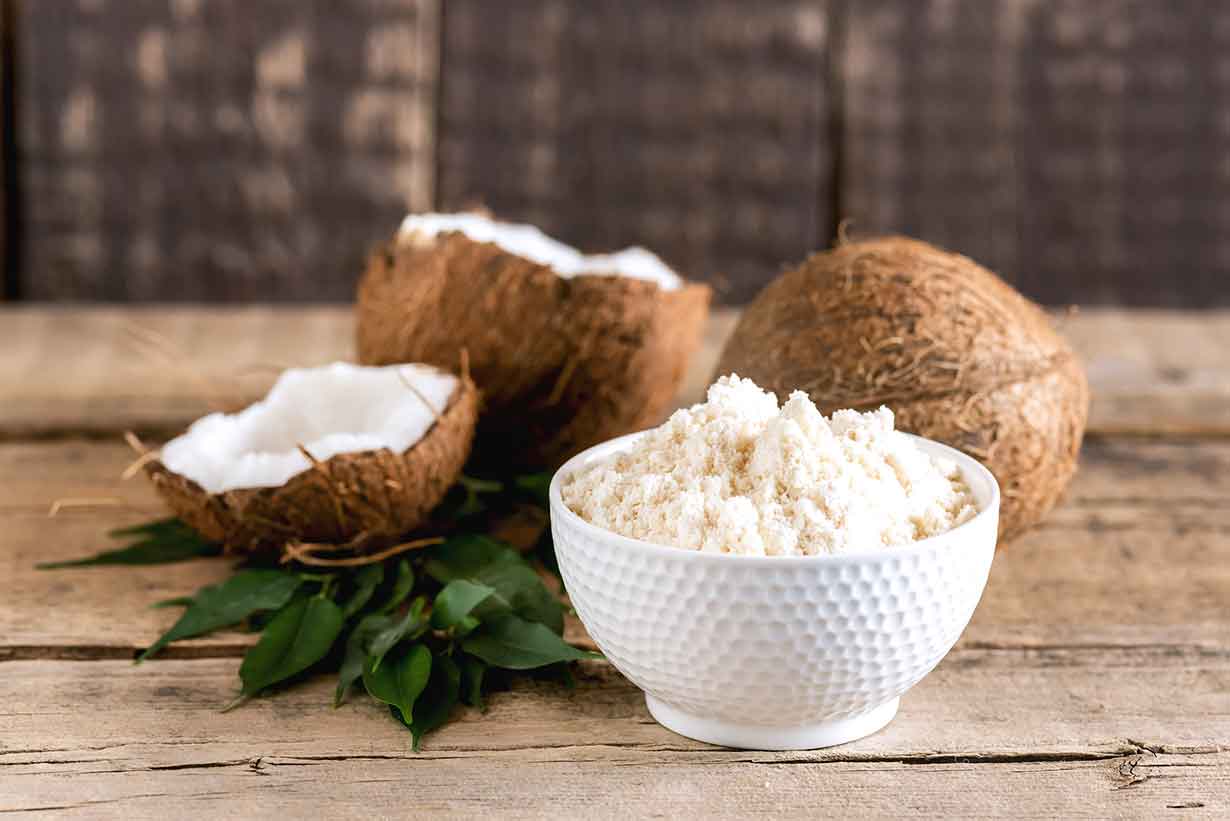
The production process of coconut flour involves defatting and drying coconut meat, and then finely grinding it. As a flour, coconut flour is a common ingredient in baked goods and it has become a popular gluten-free option for baking.
Beyond its use in baking, we can also use coconut flour as a thickener in cooked dishes or for making gluten-free (or low-carb) breadcrumbs.
Here are the key nutritional properties of coconut flour:
| Nutrient | Per 100g | Per 112g cup |
|---|---|---|
| Calories | 429 kcal | 481 kcal |
| Carbohydrates | 64.29 g | 72.01 g |
| Fiber | 35.71 g | 40.0 g |
| Sugars | 21.43 g | 24.0 g |
| Fat | 10.71 g | 12.0 g |
| Saturated | 7.14 g | 8.0 g |
| Monounsaturated | 0.46 g | 0.5 g |
| Polyunsaturated | 0.12 g | 0.13 g |
| Protein | 21.43 g | 24.0 g |
| Sodium | 71.0 mg | 79.52 mg |
Learn more: Coconut Flour: Nutrition Benefits and Drawbacks
6) Coconut Meat

You may have heard coconut meat referred to by other names, such as coconut flesh or simply coconut: they all refer to the same food.
Coconut meat is the inner white flesh of a mature coconut and it has a slightly hard, firm, and chewy texture. In terms of flavor, it is slightly sweet with nutty notes.
Coconut meat is a versatile ingredient, and it can be the base ingredient for making many of the other coconut products at home for those who like to prepare their own food.
You can also grate coconut meat on top of a dish for flavor, add it to curries to mellow out their spice, or blend it into smoothies. You can also eat it whole as a snack.
Here are the nutritional values of coconut meat:
| Nutrient | Per 100g | Per 45g piece |
|---|---|---|
| Calories | 354 kcal | 159 kcal |
| Carbohydrates | 15.2 g | 6.84 g |
| Fiber | 9.0 g | 4.05 g |
| Sugars | 6.23 g | 2.8 g |
| Fat | 33.5 g | 15.1 g |
| Saturated | 29.7 g | 13.4 g |
| Monounsaturated | 1.42 g | 0.64 g |
| Polyunsaturated | 0.37 g | 0.17 g |
| Protein | 3.33 g | 1.5 g |
| Sodium | 20 mg | 9 mg |
As with other coconut products, be aware that it is high in saturated fat; small amounts are best.
7) Coconut Milk

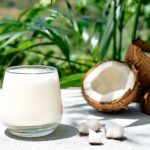
Coconut milk is among the most popular coconut products and as a white fluid, it resembles dairy milk in appearance. It is made by straining the grated flesh of coconut meat, adding hot water, and then further straining it.
Coconut milk has a similar taste to coconut cream, but it has a milder sweetness and it isn’t as thick. Since it is less concentrated, this means it also contains significantly fewer calories and grams of fat than coconut cream.
As a staple in many Asian cuisines, coconut milk often features in curries and creamy dishes. It can also be used in a wide range of desserts and beverages.
Here are the nutritional values for canned, full-fat coconut milk:
| Nutrient | Per 100g | Per 1 fl oz (30g) |
|---|---|---|
| Calories | 230 kcal | 69 kcal |
| Carbohydrates | 5.54 g | 1.66 g |
| Fiber | 2.2 g | 0.66 g |
| Sugars | 3.34 g | 1.0 g |
| Fat | 23.84 g | 7.15 g |
| Saturated | 21.14 g | 6.34 g |
| Monounsaturated | 1.01 g | 0.30 g |
| Polyunsaturated | 0.26 g | 0.08 g |
| Protein | 2.29 g | 0.69 g |
| Sodium | 15 mg | 4.5 mg |
Learn more: Is Coconut Milk a Healthy Choice?
Note: Nutritional Values Can Vary
While the above values represent USDA data for coconut milk, it is worth noting that coconut milk’s nutritional profile can vary considerably.
This is because producers may use different proportions of coconut to water, so nutritional values may vary from brand to brand.
If the exact nutritional profile is important for you, be sure to check the nutrition label carefully.
Furthermore, there are some coconut milk-based beverages sold commercially that have significantly lower fat content.
8) Coconut Oil

While coconut oil has long been a staple cooking oil in several Southeast Asian countries, it has become more prevalent in the United States and Europe over the past two decades.
Similar to the production of other edible oils, coconut oil is obtained by pressing the oils out of coconut flesh. More expensive oils tend to be cold-pressed, while some refined coconut oils use solvent extraction methods.
Coconut oil has a solid, white appearance at typical room temperatures. However, it has a low melting point and becomes a clear liquid at temperatures over approximately 78°F (25.5°C).
As well as using it for deep-frying, marinating, pan-frying, and roasting food, coconut oil is a popular ingredient in cosmetic products due to its moisturizing properties.
Here are coconut oil’s basic nutritional values:
| Nutrient | Per 100g | Per 13.6g tablespoon |
|---|---|---|
| Calories | 892 kcal | 121 kcal |
| Carbohydrates | 0 g | 0 g |
| Fiber | 0 g | 0 g |
| Sugars | 0 g | 0 g |
| Fat | 99.1 g | 13.5 g |
| Saturated fat | 82.5 g | 11.2 g |
| Monounsaturated fat | 6.33 g | 0.86 g |
| Polyunsaturated fat | 1.7 g | 0.23 g |
| Protein | 0 g | 0 g |
| Sodium | 0 mg | 0 mg |
Learn more: Coconut Oil: Nutrition Profile and Potential Health Effects
9) Shredded Coconut (Unsweetened)

In case you’re wondering, shredded coconut is interchangeable with coconut flakes. While shredded coconut may be more finely cut, the two names essentially refer to the same food product.
The ‘unsweetened’ version of shredded coconut and coconut flakes have all the same pros and cons but without the sweeter, added sugar-influenced taste. Nutritionally, unsweetened shredded coconut therefore has less sugar and more fat per gram.
Here is the nutritional composition of unsweetened shredded coconut:
| Nutrient | Per 100g | Per ounce (28.35g) |
|---|---|---|
| Calories | 660 kcal | 187 kcal |
| Carbohydrates | 23.65 g | 6.70 g |
| Fiber | 16.30 g | 4.62 g |
| Sugars | 7.35 g | 2.08 g |
| Fat | 64.53 g | 18.29 g |
| Saturated | 57.22 g | 16.22 g |
| Monounsaturated | 2.75 g | 0.78 g |
| Polyunsaturated | 0.71 g | 0.20 g |
| Protein | 6.88 g | 1.95 g |
| Sodium | 37.0 mg | 10.49 mg |
10) Coconut Vinegar
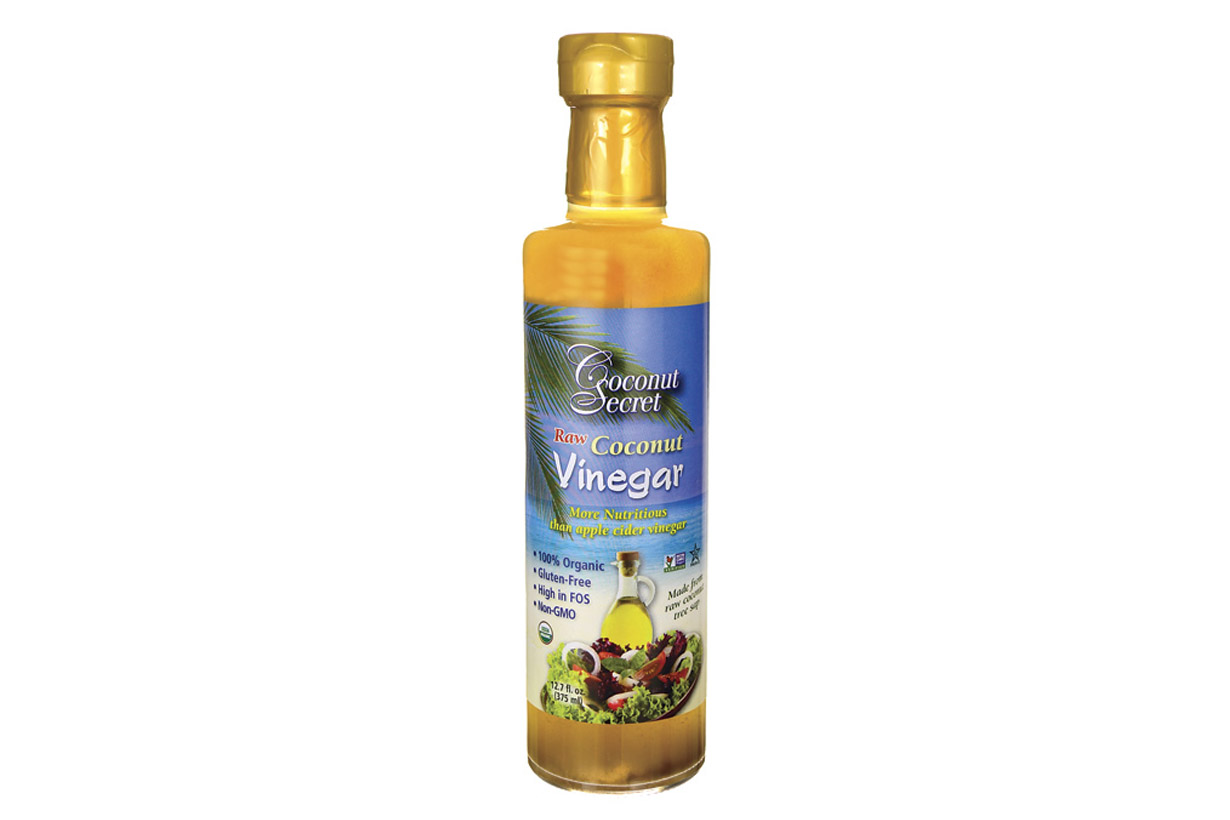
Coconut vinegar is another of the lesser-known coconut products. Its production starts similar to that of Coconut Aminos, with the initial step involving the fermentation of coconut tree sap.
However, the fermented coconut sap goes through a filtering process and is then left to age for several months, slowly turning acidic as the natural sugars it contains break down.
As with other vinegar products, coconut vinegar has a versatile range of culinary uses, including its use as an ingredient in dips, marinades, salad dressings, and sauces.
Here is the nutritional profile of coconut vinegar made by the BetterBody brand:
| Nutrient | Per 100g | Per 15-ml tablespoon |
|---|---|---|
| Calories | 0 kcal | 0 kcal |
| Carbohydrates | 0 g | 0 g |
| Fiber | 0 g | 0 g |
| Sugars | 0 g | 0 g |
| Fat | 0 g | 0 g |
| Saturated | 0 g | 0 g |
| Monounsaturated | n.d. | n.d. |
| Polyunsaturated | n.d. | n.d. |
| Protein | 0 g | 0 g |
| Sodium | 0 mg | 0 mg |
If you’re confused about the above nutritional values, it’s because coconut vinegar is mainly water and acetic acid — the main acid in all vinegars. When calorie and nutrient amounts are very low they can be rounded down to zero.
While the exact nutritional data may vary from brand to brand, coconut vinegar is not a significant source of calories and nutrients.
Learn more: Coconut Vinegar: Nutrition Facts and Potential Benefits
11) Coconut Water

Coconut water is another popular coconut product that you may have increasingly noticed in store chillers.
It has a simple production process which simply involves extracting the natural water present inside fresh, green coconuts.
While coconut water has a slightly sweet taste, its sugar content is relatively low compared to fruit juices at approximately 10 grams per cup.
It is a notable source of electrolyte minerals such as potassium, which has led to it being marketed for its use as a sports drink.
Here’s what it offers nutritionally:
| Nutrient | Per 100g | Per 245g cup |
|---|---|---|
| Calories | 18 kcal | 44 kcal |
| Carbohydrates | 4.24 g | 10.4 g |
| Fiber | 0 g | 0 g |
| Sugars | 3.92 g | 9.6 g |
| Fat | 0 g | 0 g |
| Saturated | 0 g | 0 g |
| Monounsaturated | 0 g | 0 g |
| Polyunsaturated | 0 g | 0 g |
| Protein | 0.22 g | 0.54 g |
| Sodium | 26 mg | 64 mg |
Learn more: 4 Science-Backed Benefits of Coconut Water (and Nutrition Facts)
12) Creamed Coconut
Creamed coconut is essentially the same as coconut butter nutritionally.
However, it differs slightly in texture and coconut composition, as it is dehydrated to form a solid bar-shaped form. It is a convenient ingredient that allows you to grate or chip little pieces of creamed coconut off the end for use in a dish or for topping food.
You can also heat creamed coconut which will cause it to melt and develop a texture similar to coconut butter, which may also happen naturally in warmer climates.
Here are the nutritional values for creamed coconut, which are very similar to those of coconut butter:
| Nutrient | Per 100g | Per ounce (28.35g) serving |
|---|---|---|
| Calories | 684 kcal | 194 kcal |
| Carbohydrates | 21.5 g | 6.1 g |
| Fiber | n.d. | n.d. |
| Sugars | n.d. | n.d. |
| Fat | 69.1 g | 19.6 g |
| Saturated | 61.3 g | 17.4 g |
| Monounsaturated | 2.94 g | 0.83 g |
| Polyunsaturated | 0.76 g | 0.21 g |
| Protein | 5.3 g | 1.5 g |
| Sodium | 37 mg | 10.5 mg |
13) Toasted Coconut Chips

Toasted coconut chips are a popular coconut-based snack product with a crispy texture and they typically come in a variety of flavors.
As for what they actually are, they are simply toasted coconut flakes, which may or may not have been sweetened and flavored. They tend to come in small individual bags similar to a typical bag of potato chips.
In addition to being available in a plain variety, coconut chips come in flavors ranging from chocolate to spicy cayenne-infused varieties, and those are just some of the options.
Here are the typical nutritional values of sweetened, toasted coconut chips made by the Bare Foods brand:
| Name | Per 100g | Per 24g packet |
|---|---|---|
| Calories | 542 kcal | 130 kcal |
| Carbohydrates | 54.2 g | 13.0 g |
| Fiber | 20.8 g | 4.99 g |
| Sugars | 33.3 g | 7.99 g |
| Fat | 33.3 g | 7.99 g |
| Saturated | 29.2 g | 7.01 g |
| Monounsaturated | n.d. | n.d. |
| Polyunsaturated | n.d. | n.d. |
| Protein | 4.17 g | 1.0 g |
| Sodium | 562 mg | 135 mg |
Coconut chips have a similar calorie load to single servings of potato chips. However, be aware that they can be high in added sugars and saturated fat.
Which Coconut Product Is Right For You?
As illustrated in this article, there is a wide range of coconut products with varied characteristics.
If you’re looking for a bit of energy for sports or hydration, then coconut water may be an option. Many people enjoy coconut milk and cream in cooked dishes like curries, so that may be an option too.
Overall, whether it’s adding creaminess to a cooked dish, enjoying a snack, making a marinade, or more, there’s a coconut product to meet most of these needs.
However, it’s good to be aware of their nutritional composition and the potential for over-consumption of certain nutrients like saturated fat or sodium, depending on the product.