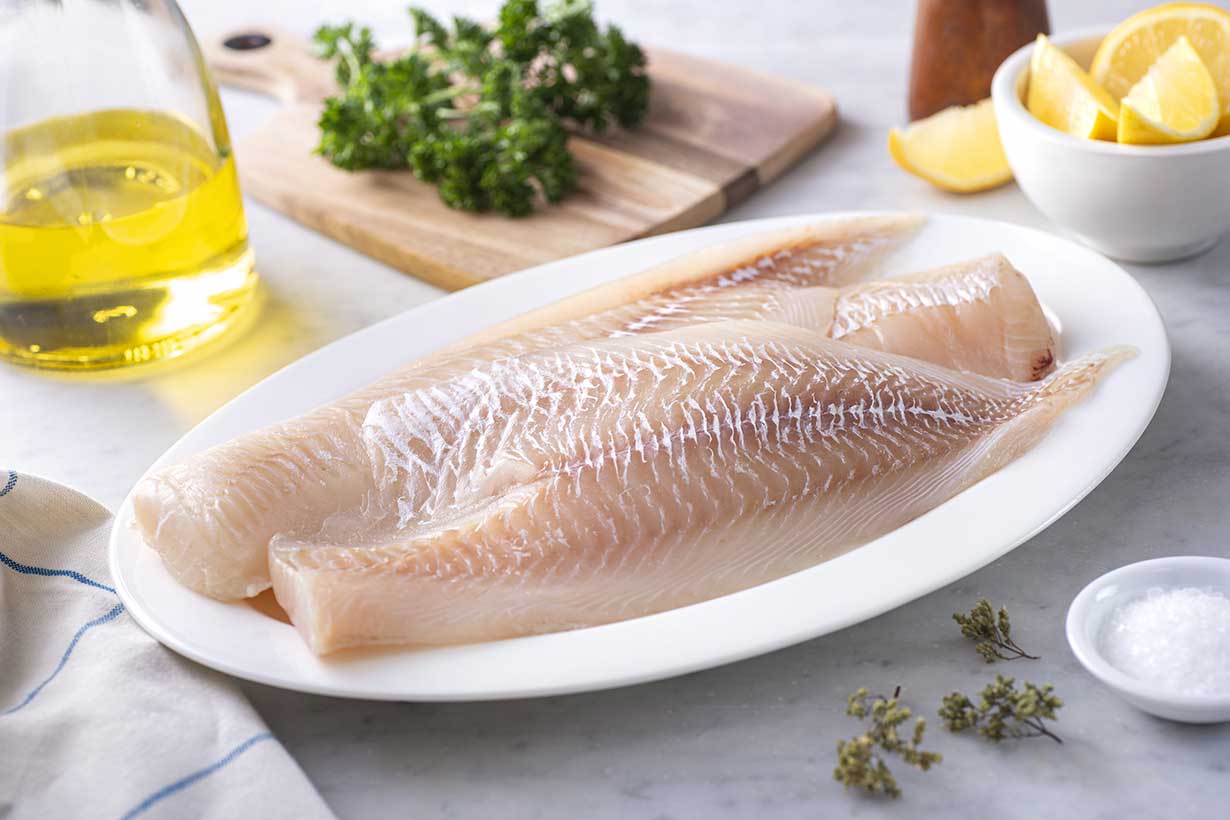
Halibut is one of the most popular culinary fish, despite its relatively high price tag.
In this article, we investigate halibut’s nutritional profile, potential benefits and drawbacks, and how it compares to other popular fish like salmon and cod.
Is the popularity of halibut solely down to its taste, or is it because it’s a healthy seafood choice?
Table of contents
Benefits
There is a lack of research specifically on halibut, but there is a broad range of scientific studies on lean fish which can provide insight into halibut’s potential health benefits.
Some benefits also come from halibut’s nutritional profile due to its high levels of specific essential nutrients, as you can see in the following sections.
High In Selenium
Halibut contains large amounts of selenium, with a cooked 1/2 fillet (159g) providing 88.1 mcg. This is equal to 160% of the daily value for selenium.
Selenium is an essential mineral with a recommended intake of 55 mcg for adults, although higher amounts are recommended in pregnancy or breastfeeding. A sufficient intake of selenium is important as, among other functions, the mineral supports:
- Antioxidant properties: Selenium is vital for the proper functioning of selenoproteins and selenoenzymes. These proteins and enzymes act as antioxidants, helping to reduce oxidative stress (cell damage) and play an important role in the immune system.
- Hormones and DNA synthesis: Selenoproteins that require selenium are also vital for producing DNA and thyroid hormones.
A 2023 umbrella review of systematic reviews found that when selenium intake is insufficient, selenium supplementation was associated with a reduced risk of several health conditions. In this context, the highest intake was associated with a 21% reduced risk of all-cause mortality compared to the lowest.
Nutritionist’s Note
People often misinterpret the findings of studies on specific nutrients, so it is important to understand what the above study means and what it doesn’t.
Firstly, I would like to emphasize that the benefits of selenium supplementation were seen when baseline selenium intake was low. This doesn’t mean that anyone will experience benefits from consuming more selenium.
However, increasing selenium intake is associated with benefits if you have a low baseline intake of the mineral or live in an area with poor soil selenium status.
In such cases, consuming more selenium-rich foods like halibut would likely have a beneficial health impact.
Rich Source of Vitamin B12 and Vitamin D
Among halibut’s vitamin profile, two standout nutrients are vitamin B12 and vitamin D.
This is because these nutrients can be difficult to consume in sufficient amounts for certain sectors of the population, such as those who:
- Consume very little meat (vitamin B12)
- Live in areas which have long, dark winters (vitamin D)
However, just a half-fillet (159g) of cooked halibut provides nearly the daily value of vitamin B12 (84%) and nearly half the daily value for vitamin D (46%).
Findings from a large 2022 umbrella review of over 280 studies found that increasing vitamin D intake was associated with a reduced risk of several chronic diseases and all-cause mortality. These associations were seen when baseline vitamin D status was low.
Additionally, vitamin B12 plays a key role in supporting the nervous system and the production of DNA and red blood cells.
May Improve Metabolic Health
The intake of lean fish, such as halibut, has been associated with improved markers of metabolic health, such as waist circumference and lipids.
A 2021 systematic review of randomized controlled trials also indicated that lean fish didn’t increase total cholesterol or “bad” LDL cholesterol levels.
While omega-3 rich oily fish generally has more supportive evidence for heart health than lean fish, this doesn’t mean that lean fish can’t be beneficial itself.
In fact, a 2023 umbrella review of observational and clinical trials investigated the impact of fish consumption on various health outcomes. The authors concluded that while oily fish may provide more benefit, “both fatty fish and lean fish are good for cardiovascular and cerebrovascular health.“
Nutritionist’s Note
Based on the existing evidence, it is likely that overall fish consumption – including lean fish – is beneficial for our health. Looking at the nutritional profile of lean fish, this could be due to its provision of several key nutrients like selenium and vitamin D.
Lean fish is also high in protein, low in calories, and has been associated with improved satiety (the feeling of fullness); these may all contribute to overall health.
Terminology note: Cardiovascular refers specifically to the health of the heart and its blood vessels, while cerebrovascular refers to brain and brain vessel health.
Potential Drawbacks
There are some drawbacks of halibut to understand, which we will discuss in the following sections.
Moderate Mercury Content
The main potential downside of halibut consumption is its mercury content. While not considered a “high-mercury” fish, it contains higher levels than other lean fish like cod and haddock.
This is because halibut are large fish that feed on smaller seafood lower in the food chain. Like all predatory fish, they accumulate more mercury.
Based on the FDA’s monitoring program of mercury levels in commercial seafood, here’s the data relevant to halibut:
- Mercury content: Halibut contained average mercury levels of 0.241 PPM. This is equivalent to a mercury content of 0.241 mg per kilogram.
- Sample size: This mercury content was the mean (average) mercury concentration across 101 samples of halibut. This large sample size can give us confidence that the mercury content is likely to be (approximately) accurate.
This mercury level is moderate – it is not as low as seen in fish like sardines (0.013 PPM), but nor is it as high as levels observed in swordfish (0.995 PPM).
Joint advice from the FDA and EPA suggest that halibut is a “good” but not “best” choice for limiting mercury intake. For pregnant or breastfeeding women, “good” choices are recommended no more than once per week at a serving size of 4oz (120g).
More Expensive Than Similar Lean Fish
While some people may prefer the taste of halibut, it is scarcer than common fish like cod and haddock. Due to this, halibut typically sells at more than double the price.
If you enjoy and can comfortably afford halibut, that’s great. However, fish like haddock offer a relatively similar nutrient profile for a cheaper price.
Nutritional Profile
Now that we know some of the potential benefits and drawbacks of halibut consumption, let’s look at the full list of nutrients it provides.
The following tables present the complete nutritional profile of cooked halibut (Atlantic/Pacific) both per 100g and per 159g half-fillet.
The data source is the USDA’s FoodData Central halibut entry, and we have calculated percent daily values (% DV), which are based on a 2,000 calorie diet.
Calories and Macronutrients
| Nutrient | Per 100g (% DV) | Per 159g 1/2 fillet (% DV) |
|---|---|---|
| Calories | 111 kcal | 176 kcal |
| Carbohydrates | 0g (0%) | 0g (0%) |
| Fiber | 0g (0%) | 0g (0%) |
| Fat | 1.61g (2%) | 2.56g (3%) |
| Saturated fat | 0.35g (2%) | 0.56g (3%) |
| Monounsaturated fat | 0.57g | 0.91g |
| Polyunsaturated fat | 0.35g | 0.56g |
| Omega-3 | 0.28g | 0.44g |
| Omega-6 | 0.07g | 0.12g |
| Protein | 22.5g (45%) | 35.8g (72%) |
| Cholesterol | 60 mg (20%) | 95 mg (32%) |
From the table, you’ll notice that halibut is an excellent source of protein. It provides 22.5 grams of protein per 100g for only 111 calories, which is similarly protein-dense to cooked chicken breast.
Vitamins
| Vitamin | Per 100g (% DV) | Per 159g 1/2 fillet (% DV) |
|---|---|---|
| Vitamin A (RAE) | 24 mcg (3%) | 38.2 mcg (4%) |
| Vitamin C | 0 mg (0%) | 0 mg (0%) |
| Vitamin D | 5.8 mcg (29%) | 9.22 mcg (46%) |
| Vitamin E | 0.74 mg (5%) | 1.18 mg (8%) |
| Vitamin K | 0 mcg (0%) | 0 mcg (0%) |
| Thiamin (B1) | 0.06 mg (5%) | 0.09 mg (8%) |
| Riboflavin (B2) | 0.04 mg (3%) | 0.06 mg (5%) |
| Niacin (B3) | 7.91 mg (49%) | 12.6 mg (79%) |
| Pantothenic acid (B5) | 0.42 mg (8%) | 0.66 mg (13%) |
| Vitamin B6 | 0.63 mg (37%) | 1 mg (59%) |
| Folate (B9) | 14 mcg (4%) | 22.3 mcg (6%) |
| Vitamin B12 | 1.27 mcg (53%) | 2.02 mcg (84%) |
| Choline | 75.1 mg (14%) | 119 mg (22%) |
Per 100 grams, cooked halibut provides high amounts of niacin and vitamins B6, B12, and D.
Minerals
| Mineral | Per 100g (% DV) | Per 159g 1/2 fillet (% DV) |
|---|---|---|
| Calcium | 9 mg (1%) | 14.3 mg (1%) |
| Iron | 0.2 mg (1%) | 0.32 mg (2%) |
| Magnesium | 28 mg (7%) | 44.5 mg (11%) |
| Phosphorus | 287 mg (23%) | 456 mg (36%) |
| Potassium | 528 mg (11%) | 840 mg (18%) |
| Sodium | 82 mg (4%) | 130 mg (6%) |
| Zinc | 0.43 mg (4%) | 0.68 mg (6%) |
| Copper | 0.03 mg (3%) | 0.05 mg (6%) |
| Manganese | 0.01 mg (<1%) | 0.02 mg (1%) |
| Selenium | 55.4 mcg (101%) | 88.1 mcg (160%) |
Each 100 grams of cooked halibut provides significant amounts of selenium and high levels of phosphorus.
How Halibut Compare to Other Popular Fish
To help you with your purchase decisions, the table below allows you to compare halibut to two other popular species of fish: cod and salmon.
You can see how all three fish compare for calories, fat, omega-3, protein, mercury content, and typical cost.
USDA nutritional data for halibut (Pacific/Atlantic), cod (Atlantic), and salmon (farmed, Atlantic) per 100 grams is the source of nutrient values.
The FDA monitoring program is the source of mercury content data.
| Metric | Halibut | Cod | Salmon |
|---|---|---|---|
| Calories (per 100g) | 111 kcal | 105 kcal | 206 kcal |
| Fat (per 100g) | 1.61g | 0.86g | 12.4g |
| Omega-3 (per 100g) | 0.28g | 0.17g | 2.62g |
| Protein (per 100g) | 22.5g | 22.8g | 22.1g |
| Mercury content (PPM) | 0.241 | 0.111 | 0.02 |
| Typical cost | High | Medium | Medium |
As the table shows, here’s how halibut compares for different metrics you might consider:
- Calories: Halibut contains a similar calorie content to cod, but only around half the calories that salmon typically provides. For those prioritizing protein-dense, low-calorie foods, halibut is a better option than salmon and similar to cod.
- Protein: There is no significant difference between halibut, cod, and salmon for absolute protein content. In this regard, all fish are good protein sources.
- Omega-3: If you’re trying to boost your omega-3 intake, there’s no comparison. Salmon is an oily fish that provides far more omega-3 than halibut.
- Limiting mercury exposure: While still considered a “good” choice by the FDA and EPA, halibut does contain significantly more mercury than salmon. It also has about double the typical mercury content of cod.
- Cost: Halibut is priced at significantly higher levels than salmon or cod. If you enjoy the flavor and don’t mind the extra cost, then halibut may be the right choice for you. However, cod provides a similar nutritional profile for significantly less expense.
Summary
As shown throughout this guide, halibut is a lean fish that offers significant nutritional value for relatively few calories.
It may potentially provide health benefits due to the high levels of selenium, vitamin D, and other key nutrients. Research also supports lean fish potentially having a beneficial impact on long-term health outcomes, as seen in a large 2023 review study.
However, due to its lower stocks and premium positioning, halibut tends to cost more than other lean fish species. It also contains more mercury than other common fish like cod, salmon, and sardines.
Whether halibut is the right choice for you depends on balancing its nutrient provision, overall characteristics, and relative expense. However, it is likely a beneficial addition to the typical diet when consumed in moderation.
References
Full List of Scientific References
(Click to Expand)
All citations used within this article are listed below, with full details for each scientific source.
- USDA (2019). Fish, halibut, Atlantic and Pacific, cooked, dry heat, nutrients. View USDA data for halibut
- National Institutes of Health. (2025). Selenium – Health Professional Fact Sheet. View National Institutes of Health information
- Puze Wang et al. (2023). Selenium intake and multiple health-related outcomes: an umbrella review of meta-analyses. View study in the Frontiers in Nutrition journal
- Di Liu et al. (2022). Vitamin D and multiple health outcomes: An umbrella review of observational studies, randomized controlled trials, and mendelian randomization studies. View study in the Advances in Nutrition journal
- National Institutes of Health. (2025). Vitamin B12 – Health Professional Fact Sheet. View National Institutes of Health information
- Christine Torris et al. (2017). Lean fish consumption is associated with beneficial changes in the metabolic syndrome components: A 13-year follow-up study from the Norwegian Tromso study. View study in Nutrients journal
- Janet C. Tou et al. (2022). Lipid-modifying effects of lean fish and fish-derived protein consumption in humans: A systematic review and meta-analysis of randomized controlled trials. View study in Nutrition Reviews journal
- Hailiang Zhao et al. (2023). Fish consumption in multiple health outcomes: an umbrella review of meta-analyses of observational and clinical studies. View study in the Annals of Translational Medicine journal
- A. M. Uhe et al. (1992). A comparison of the effects of beef, chicken and fish protein on satiety and amino acid profiles in lean male subjects. View study at the National Library of Medicine
- U.S. Food & Drug Administration (FDA). (2022). Mercury levels in commercial fish and shellfish (1990–2012). View FDA data
- U.S. Food & Drug Administration (FDA). (2024). Advice about eating fish. View FDA data
- USDA. (2019). Chicken, broilers of fryers, breast, meat only, cooked, nutrients. View USDA data
- USDA. (2019). Fish, cod, Atlantic, cooked, nutrients. View USDA data
- USDA. (2019). Fish, salmon, Atlantic, farmed, cooked, nutrients. View USDA data