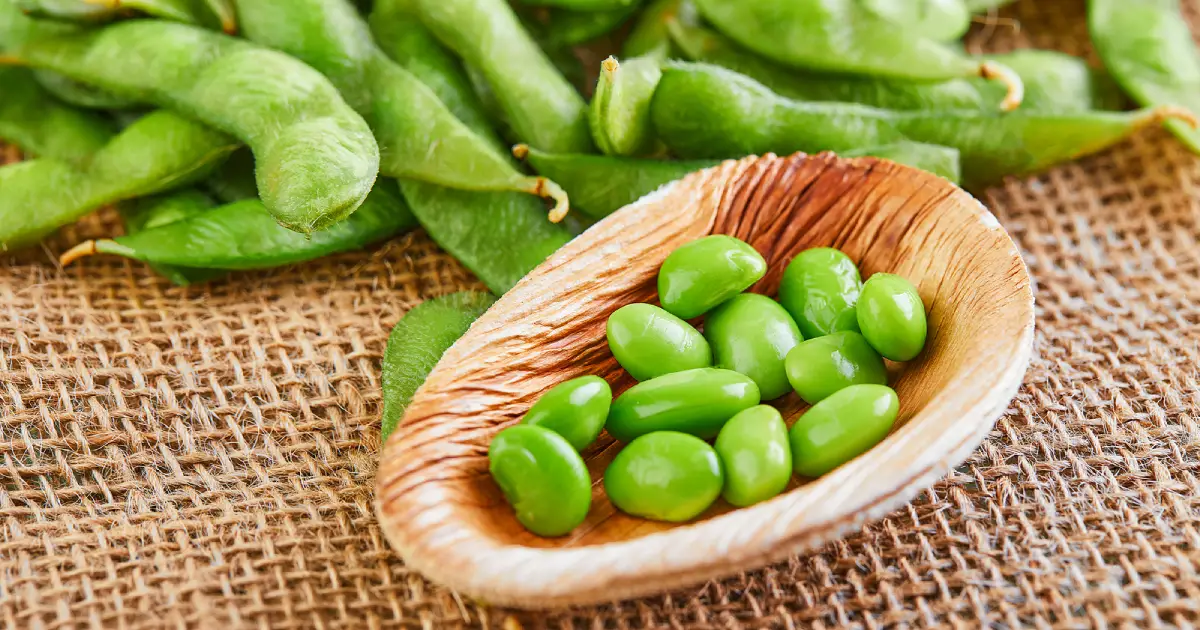
Edamame refers to small, green soybeans that provide a notable amount of protein, fiber, and essential nutrients, including copper, folate, magnesium, and vitamin K.
A single 155g cup of cooked edamame contains 188 calories and provides 18.4 grams of protein and 8.1 grams of fiber.
In addition to its key nutrients, edamame is also a rich source of isoflavonoids like malonyldaidzin, daidzin, and genistin. These are all bioactive compounds that belong to the wider polyphenol class of compounds.
Research suggests that edamame may have potential benefits for blood pressure, blood sugar, and cholesterol. However, edamame is a soy food, and since soy is one of the nine “big” allergens, edamame will be unsuitable for the many people living with a soy allergy.
Edamame vs. Regular Soybeans
Before we look at the nutrition and health properties of edamame, let’s first explain how it is different from regular, mature soybeans.
- Edamame: Immature soybeans that are harvested when the beans are still fresh and green in color.
- Soybeans: Regular soybeans are picked several weeks after edamame is harvested. During this extra time, the beans change to a yellowish-beige color and naturally dry out.
Although both edamame and soybeans are the same bean at different times in its lifecycle, there are some nutritional differences between the two:
- Water content: Cooked edamame is approximately 73% water by weight, whereas cooked mature soybeans have a lower water content of around 62%.
- Nutrient density: Since mature soybeans have less water, they are a more concentrated source of most nutrients, including protein and fat.
- Calories: Since they contain more carbohydrates, fat, and protein and less water, mature soybeans are higher in calories than edamame. For example, USDA data shows a 172g cup of cooked mature soybeans has 296 calories while a 155g cup of cooked edamame contains 188 calories.
- Fat composition: Interestingly, research suggests edamame has a lower amount of the omega-6 fat, linoleic acid, than mature soybeans.
- Monounsaturated and polyunsaturated fat: According to USDA data, cooked edamame is 1.3% monounsaturated and 2.2% polyunsaturated fat by weight. In contrast, cooked mature soybeans are 2% monounsaturated fat but are 5% polyunsaturated fat by weight.
- Carotenoids and folate: Edamame contains higher amounts of specific nutrients than mature soybeans, with research showing it has at least double the content of carotenoids and folate.
While both edamame and soybeans are technically legumes, edamame is commonly sold, perceived, and consumed as a vegetable.
Potential Benefits of Edamame
There is a significant body of research on soy foods, but only a small number of studies on the health effects of edamame specifically.
In this section, we’ll focus on both the findings on edamame and the wider soy research, and look at how they both fit together.
May Lower Blood Pressure
A 2026 systematic review examined data from seven observational studies involving 278,200 participants to investigate the relationship between soy intake and hypertension (high blood pressure).
Among the review’s findings, high intake of soy was associated with a 19% reduced risk of hypertension compared to low intake.
The evidence quality was thought to support a probable causal relationship between soy consumption and a subsequent lower risk of developing hypertension.
While this review was not specifically on edamame, edamame is a soy food. It also contains several nutrients and compounds associated with blood pressure benefits, including:
- Fiber: A 2023 systematic review found that increased fiber intake is associated with lower blood pressure.
- Potassium: An electrolyte mineral that plays a role in blood pressure regulation. Higher dietary intake is associated with lower blood pressure.
- Soy isoflavones: Isoflavones are a class of isoflavonoids, which are polyphenols found in soy. A 2024 systematic review of 24 studies found that soy isoflavone supplementation significantly lowers blood pressure.
High in Plant-Based Protein and Fiber
Edamame is an excellent source of protein, with a cup serving offering 18.4 grams.
Since it is plant-based protein, edamame is among the best protein options for vegetarians and vegans. Soy contains all nine essential amino acids, so it is considered a complete source of protein.
Unlike most protein sources, a cup of edamame also contributes a good amount of fiber to your diet with 8.1 grams per cup.
Can Edamame Lower Blood Sugar Levels?
A 2026 study assessed how edamame intake was associated with fasting blood sugar levels in a cross-sectional assessment of 258 adults at risk of metabolic syndrome.
This analysis found a consistent association between high edamame intake and lower fasting blood sugar levels.
The finding fits with the results from a broader 2026 meta-analysis of randomized controlled trials, which found that:
- Whole soy lowered blood sugar: Among the various soy products, whole soy foods were most effective for lowering blood sugar levels. However, the authors rated the overall quality of the evidence as “low or very low,” which means we can’t be certain about their findings.
- Edamame recommendation: The researchers noted that 80g of edamame could be a daily serving of whole soy foods, with 1-2 servings per day being recommended.
While other compounds in edamame like isoflavonoids may contribute, it is likely that edamame’s high fiber content plays a role in these blood sugar effects. Research consistently finds that fiber plays a key role in improving blood sugar regulation.
May Lower LDL Cholesterol
LDL cholesterol (LDL-C) is a causal risk factor for cardiovascular disease (you may know it as “bad cholesterol”) so foods that can potentially lower it may benefit heart health.
While there is no research specifically on edamame, there is wider research on soy protein, which is very relevant to edamame:
- Soy protein study: A 2019 meta-analysis of 46 controlled trials found that soy protein lowers LDL-C. In the study, a median daily dose of 25 grams lowered LDL-C by 4.76 mg/dL (0.12 mmol/L).
- Protein equivalent from edamame: 25 grams of soy protein is equivalent to approximately 211 grams of cooked edamame. This is slightly less than 1.5 cups, which would be 233g.
Several of the nutrients and compounds in edamame are more broadly thought to help support lower cholesterol levels, including:
- Soy protein
- Fiber
- Unsaturated fats (particularly polyunsaturated fat)
What this means: Since edamame is a rich source of soy protein, fiber, and unsaturated fats, it may help lower LDL-C depending on what it substitutes in the diet. For example, it should lower LDL-C compared to foods that are high in saturated fats. If edamame replaced nuts or seeds, there may be no significant effect.
How Processing Impacts Edamame Nutrients
If you want the most nutrients from your edamame, it is worth understanding how processing can impact the absolute amounts of specific nutrients and compounds.
For example, research has found processing edamame leads to changes in its concentrations of carotenoids and isoflavones:
- Boiling and isoflavones: Boiling edamame actually increases its content of daidzin, genistin, and genistein, which are isoflavone polyphenols. This is because heat breaks down some isoflavones in edamame into simpler forms.
- Boiling and carotenoids: After boiling edamame, it retained an average of 62% of its lutein and beta-carotene content, both of which are carotenoids.
- Freeze-drying and carotenoids: After freeze-drying, edamame’s carotenoid content significantly falls. Only 34% of lutein and 27% of beta-carotene were retained on average. (Note: Freeze-drying is one of the processes used to create crunchy dried edamame snacks, though many are dry-roasted.)
- Regular freezing and carotenoids: Frozen edamame retained 92% of lutein and 73% of beta-carotene on average.
If you care specifically about its carotenoid composition, then choosing fresh edamame and cooking it gently is likely the best choice. While the study didn’t report carotenoid retention after freezing and boiling, it is likely to be lower than the above figures.
Potential Downsides of Edamame
Due to soy allergies, edamame may not be suitable for some people, and it also contains antinutrients that can affect digestion.
Edamame and Allergies
Edamame is literally a soybean before it reaches its mature, dry stage.
For this reason, it unfortunately won’t be a good choice for people with a soy allergy.
Soy is one of the nine major food allergens alongside foods like nuts, eggs, and dairy. Results from a population study of 40,443 U.S. adults suggest that 1.5 million Americans may have a soy allergy.
Anyone with a suspected soy allergy or history of reactions with soy-based foods should consult their healthcare provider before consuming edamame.
Edamame Contains Antinutrients
Raw edamame contains antinutrients at levels that can potentially impair protein digestion and cause gastrointestinal symptoms:
- Trypsin inhibitors: Edamame contains trypsin inhibitors such as Bowman-Birk inhibitor. Trypsin is an enzyme the body uses to break down and digest protein, so trypsin inhibitors impair protein digestion from edamame.
- Lectins: Raw edamame contains lectins, such as hemagglutinin, which are antinutrients that can cause gastrointestinal symptoms.
The good news: Properly cooking edamame significantly reduces its trypsin inhibitor and lectin activity, making edamame easy to digest.
Edamame Nutrition Facts
In the following tables, you’ll find the full calorie, macronutrient, and vitamin and mineral composition of cooked edamame per 100g and per 155g cup. Where appropriate, we have calculated Percent Daily Values (% DV).
Nutrition data source: USDA – Edamame, cooked from frozen
| Nutrient | Per 100g (% DV) | Per 155g cup (% DV) |
|---|---|---|
| Calories | 121 kcal | 188 kcal |
| Carbohydrates | 8.91g (3%) | 13.8g (5%) |
| Fiber | 5.2g (19%) | 8.06g (29%) |
| Sugars | 2.18g | 3.38g |
| Fat | 5.2g (7%) | 8.06g (10%) |
| Saturated fat | 0.62g (3%) | 0.96g (5%) |
| Monounsaturated fat | 1.28g | 1.98g |
| Polyunsaturated fat | 2.16g | 3.35g |
| Omega-3 | 0.36g | 0.56g |
| Omega-6 | 1.79g | 2.78g |
| Protein | 11.9g (24%) | 18.4g (37%) |
| Cholesterol | 0 mg (0%) | 0 mg (0%) |
As the table shows, edamame is relatively unique among foods in that it contains moderate-to-high amounts of fiber, fat, and protein.
Vitamins
| Vitamin | Per 100g (% DV) | Per 155g cup (% DV) |
|---|---|---|
| Vitamin A (RAE) | 15 mcg (2%) | 23.2 mcg (3%) |
| Vitamin C | 6.1 mg (7%) | 9.46 mg (11%) |
| Vitamin D | 0 mcg (0%) | 0 mcg (0%) |
| Vitamin E | 0.68 mg (5%) | 1.05 mg (7%) |
| Vitamin K | 26.7 mcg (22%) | 41.4 mcg (35%) |
| Thiamin (B1) | 0.2 mg (17%) | 0.31 mg (26%) |
| Riboflavin (B2) | 0.16 mg (12%) | 0.24 mg (18%) |
| Niacin (B3) | 0.92 mg (6%) | 1.42 mg (9%) |
| Pantothenic acid (B5) | 0.40 mg (8%) | 0.61 mg (12%) |
| Vitamin B6 | 0.1 mg (6%) | 0.16 mg (9%) |
| Folate (B9) | 311 mcg (78%) | 482 mcg (121%) |
| Vitamin B12 | 0 mcg (0%) | 0 mcg (0%) |
| Choline | 56.3 mg (10%) | 87.3 mg (16%) |
As the table shows, a cup of cooked edamame provides high amounts (≥20% DV) of thiamin, vitamin K, and folate.
Minerals
| Mineral | Per 100g (% DV) | Per 155g cup (% DV) |
|---|---|---|
| Calcium | 63 mg (5%) | 97.6 mg (8%) |
| Iron | 2.27 mg (13%) | 3.52 mg (20%) |
| Magnesium | 64 mg (15%) | 99.2 mg (24%) |
| Phosphorus | 169 mg (14%) | 262 mg (21%) |
| Potassium | 436 mg (9%) | 676 mg (14%) |
| Sodium | 6 mg (<1%) | 9.3 mg (<1%) |
| Zinc | 1.37 mg (12%) | 2.12 mg (19%) |
| Copper | 0.35 mg (39%) | 0.54 mg (60%) |
| Manganese | 1.02 mg (44%) | 1.58 mg (69%) |
| Selenium | 0.8 mcg (1%) | 1.24 mcg (2%) |
Edamame is a rich source of numerous minerals, with a cup serving providing high amounts of manganese, copper, magnesium, phosphorus, and iron.
Is Edamame a Healthy Choice for You?
Edamame provides substantial amounts of fiber, protein, manganese, copper, folate, vitamin K, magnesium, and more.
The available research on edamame, particularly when combined with the wider research on soy in general, suggests that it may help lower LDL cholesterol, blood pressure, and fasting blood sugar.
However, more research is necessary to confirm this, and these potential benefits will depend on the overall diet and what edamame replaces.
For most people, edamame is a healthy, nutrient-rich addition to the diet.
Learn more about vegetables: 60 Types of Vegetables and Their Nutrition Facts
References
Full List of Scientific References (Select to Expand)
All citations used within this article are listed below, with full details for each scientific source.
- USDA. (2019). Edamame, frozen, prepared. View USDA edamame data
- USDA. (2019). Soybeans, mature cooked, boiled, without salt. View USDA soybean data
- Devireddy Meghana et al. (2025). Nutritional analysis of vegetable soybean [Glycine max (L.) Merill] accessions in Eastern India. View study in Frontiers in Nutrition
- Kwadwo Gyapong Agyenim-Boateng et al. (2022). The nutritional composition of the vegetable soybean (maodou) and its potential in combatting malnutrition. View study in Frontiers in Nutrition
- Michael Metoudi et al. (2026). Legume and soy consumption and the risk of hypertension: A systematic review and dose-response meta-analysis of prospective studies. View study in BMJ Nutrition, Prevention & Health
- Vitrag N. Tejani et al. (2023). The relationship between dietary fiber intake and blood pressure worldwide: A systematic review. View study in Cureus
- Tommaso Filippini et al. (2020). Potassium intake and blood pressure: A dose-response meta-analysis of randomized controlled trials. View study in the Journal of the American Heart Association
- Lifu Lei et al. (2024). Effect of soy isoflavone supplementation on blood pressure: A meta-analysis of randomized controlled trials. View study in Nutrition Journal
- Aaron J. Michelfelder (2009). Soy: A complete source of protein. View study in American Family Physician
- Guoqing Ma et al. (2026). Legume intake and glycemic control in individuals with or at risk of metabolic syndrome: Multi-omics insights from both observational and interventional research. View study in Molecular Nutrition & Food Research
- Qiuping Luo et al. (2025). Comparative effects of different types of soy products on glycemic control and insulin sensitivity: A network meta-analysis of randomized controlled trials. View study in Frontiers in Nutrition
- Hatice Colak et al. (2025). Effects of isolated single fibers, fiber mixtures, and fiber-rich whole foods on glucose homeostasis in individuals with overweight and obesity: A systematic review and meta-analysis. View study in Clinical Nutrition
- Blanco Mejia Sonia et al. (2019). A meta-analysis of 46 studies identified by the FDA demonstrates that soy protein decreases circulating LDL and total cholesterol concentrations in adults. View study in the Journal of Nutrition
- A. H. Simonne et al. (2000). Retention and changes of soy isoflavones and carotenoids in immature soybean seeds (edamame) during processing. View study in the Journal of Agricultural and Food Chemistry
- Ruchi S. Gupta et al. (2019). Prevalence and severity of food allergies among US adults. View study in JAMA Network Open
- Zhanjun Luo et al. (2025). Advancements in inactivation of soybean trypsin inhibitors. View study in Foods journal
- Anezka Adamcova et al. (2021). Lectin activity in commonly consumed plant-based foods: Calling for method harmonization and risk assessment. View study in Foods journal