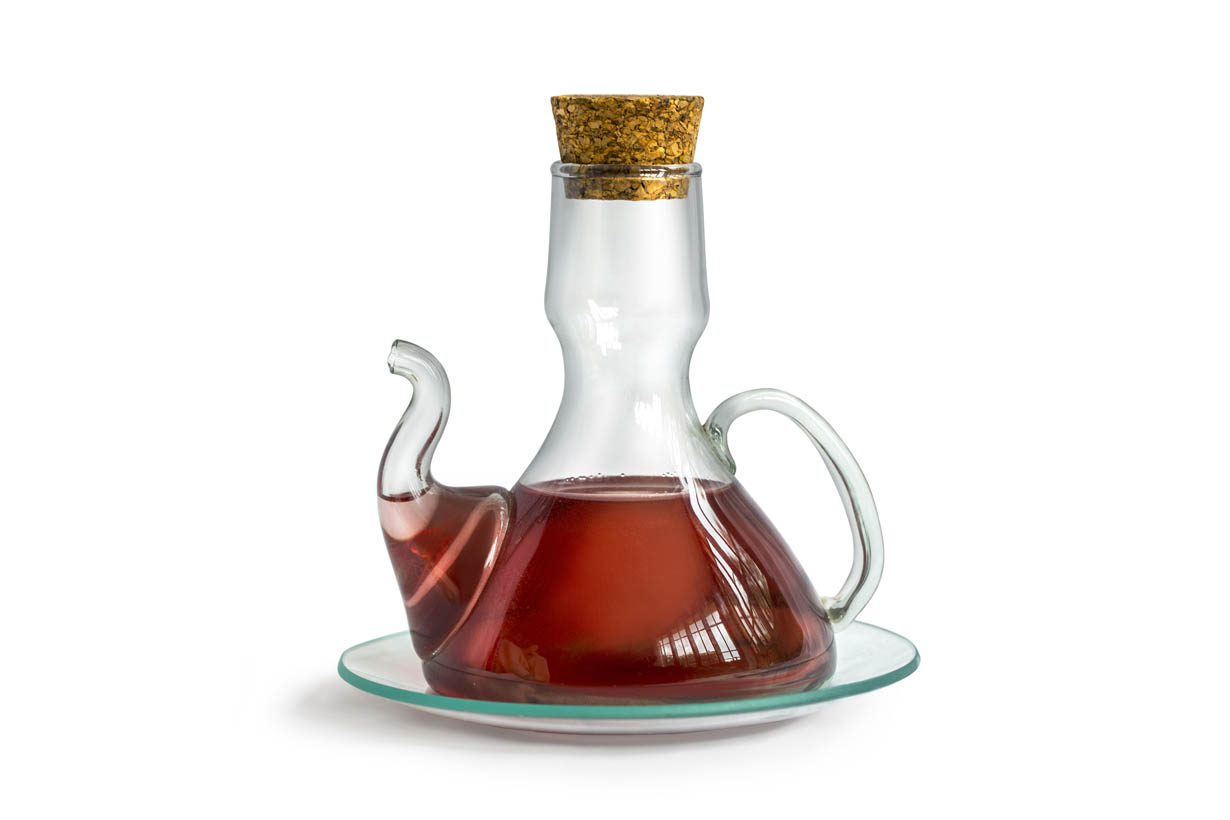
Before we look at the science of red wine vinegar, let’s first explain precisely what it is.
The process of producing red wine vinegar begins with red wine. The wine is stored while still exposed to oxygen, which results in its alcohol content slowly fermenting into acetic acid. Acetic acid is the acid that gives all vinegar its characteristic sharp and tart flavor.
Once this alcohol content has become extremely low, the red wine has technically become red wine vinegar. However, regarding specifics, the U.S. Food and Drug Administration (FDA) state that all products labeled with red wine vinegar should contain at least 4g of acetic acid per 100 ml.
Red wine vinegar can either be pasteurized or raw and unpasteurized. Pasteurization is a high-heat treatment that kills bacteria, but it can also kill potentially beneficial “good” bacteria.
Red wine vinegar is extremely popular in some countries, and it is a staple in French, Greek, Italian, and Spanish cuisine. It is typically used as a flavor-enhancer in cooking or as part of a vinaigrette for salads.
What Nutrients Are in Red Wine Vinegar?
Considering that red wine vinegar is typically consumed in serving sizes of a tablespoon or less, it is not a significant source of nutrients.
However, the following sections show the nutritional data for red wine vinegar per 100g and per typical 14.9g tablespoon serving.
Table 1: Nutritional content of red wine vinegar per 100g and per 14.9g tablespoon with percent daily values (% DV)
As the data shows, red wine vinegar contains virtually no calories or macronutrients.
Vitamins and Minerals
Red wine vinegar also contains trace amounts of minerals including iron, magnesium, manganese, and potassium.
However, the values are extremely low, and it isn’t a particularly good source of micronutrients.
As an example, red wine vinegar provides the following vitamin and mineral content per 100g:
Iron: 0.45 mg (3% DV)
Manganese: 0.05 mg (2% DV)
Potassium: 39 mg (1% DV)
Magnesium: 4 mg (1% DV)
Nutritionist’s Note
While red wine vinegar does contain a small amount of vitamins and minerals, remember that people don’t consume 100g of red wine vinegar at a time. At a more realistic dose of a 14.9g tablespoon or even a 5g teaspoon, the amount of vitamins and minerals present would be negligible.
Red wine vinegar isn’t a significant source of essential vitamins or minerals.
Polyphenols and Bioactive Compounds
Red wine vinegar contains a similar range of polyphenols as the red wine it’s made from, but in smaller quantities.
Red wine vinegar also contains acetic acid at around 4% or higher of total weight. Acetic acid is a compound found in all vinegars, from apple cider vinegar and coconut vinegar to red wine vinegar.
Acetic acid has a distinctly sharp, sour flavor.
Potential Benefits of Red Wine Vinegar
Can including red wine vinegar in our diet have potential health benefits? In this section, we look at what the science says and clarify what that means for you.
Blood Sugar Regulation
There have been mixed findings on the potential impact of red wine vinegar, and vinegar in general, on blood glucose:
A 2019 randomized controlled trial involving 45 people tested the impact of a daily dose of red wine vinegar at mealtime. The study found this led to significantly lower blood sugar and insulin levels over eight weeks. However, this is only one relatively small study, and the wider evidence base is more uncertain.
A 2021 systematic review of 16 studies assessed the effect of acetic acid supplementation on blood sugar levels. While acetic acid is not specifically red wine vinegar, it is the active compound behind the potential benefits of red wine vinegar. This review found a trend toward acetic acid significantly lowering fasting blood sugar. However, the “trend” here is because the data was uncertain and not definite. In other words, the results hinted at a blood sugar-lowering effect but weren’t statistically significant enough to confirm it.
An earlier 2020 systematic review of six studies found that vinegar consumption may improve fasting blood sugar levels. However, the authors noted that there was uncertainty in the results, some studies used different doses, and that the included studies were relatively small.
Nutritionist’s Note
Looking at the research on blood sugar, you may be wondering what it all means. Basically, the main takeaway should be this: There is some promising research on the potential benefits of red wine vinegar for blood sugar control, but there is also significant uncertainty.
Based on the existing research, this uncertainty comes from small sample sizes (small participant groups in studies), and a lack of statistical significance. Both of these factors significantly impact the amount of confidence we can have in generalizing the results of a scientific study as being true for the population in general.
If red wine vinegar can have blood sugar-related benefits, the effect is likely to be relatively modest, and it is by no means a magic supplement.
As with anything in nutrition, focusing on the whole dietary pattern should take priority, and blood sugar management should be guided by personalized advice from a trusted healthcare provider.
Vinegar May Help Support Lower Blood Pressure
A 2022 systematic review of four randomized controlled trials found that vinegar consumption may reduce blood pressure.
Findings from the study included:
Blood pressure drops: Every 30-gram increase in daily vinegar intake had a dose-response impact on lowering both systolic and diastolic blood pressure.
Evidence quality: The ‘certainty of the evidence’ was rated as low by the researchers involved. This was due to the small number of studies, the short duration of the included studies, and a lack of information on whether participants were using blood pressure-lowering medication.
Based on this, we can only know that vinegar intake “may” have a beneficial effect on blood pressure, with a lack of certainty.
However, prior research has investigated mechanisms for how vinegar may have blood pressure-lowering properties.
For instance, a 2005 animal study provided a red wine vinegar and grape juice-based beverage to rats with high blood pressure. The study found evidence for this beverage potentially having blood pressure-lowering properties due to its inhibition of an enzyme (Angiotensin-Converting Enzyme) that can raise blood pressure.
Nutritionist’s Note
Once again, it is worth noting that the above studies focused on vinegar (and acetic acid) rather than red wine vinegar specifically. It is also important to understand the limitations of animal studies, and why they should be interpreted cautiously.
In short, findings from an animal study cannot confirm the same effect would be seen in humans. Additionally, doses given to the rats in the 2005 study were significant (3 ml per kg), which would be the equivalent of a 210 ml serving for a human weighing 70kg – which is unrealistic.
Ways to Use Red Wine Vinegar
There are many uses of red wine vinegar and some of the most common ways include;
Salad dressings
People use red wine vinegar to make a salad dressing (also known as a vinaigrette).
There are lots of recipes online just a search away. However, a good base could be mixing a tablespoon of red wine vinegar with a tablespoon of extra virgin olive oil and a dash of salt to taste.
From there, you can add any favored ingredients, which may include flavorful seasonings like garlic and rosemary.
Reductions
Making a red wine vinegar reduction involves heating the vinegar, bringing it to a boil, and then allowing it to simmer to reduce the water content.
Over time, the water evaporates which results in a thicker consistency liquid that can be used as a “sauce” base, a marinade, or a condiment for food in general.
This reduction would work well with a wide range of protein foods, from steak, poultry and fish to tofu and tempeh.
Final Thoughts
Red wine vinegar can be a flavor-enhancing addition to a wide range of foods and is likely a neutral to healthful dietary addition.
While research indicates it may potentially have properties that help support blood pressure and blood sugar levels, the certainty of evidence for this is low. Any potential benefits in this area are likely to be modest, particularly compared to conventional treatment.
Lastly, and importantly, individuals actively managing their blood sugar and blood pressure levels should follow personalized guidance from a trusted healthcare provider.
References
Full List of Scientific References
(Click to Expand)
All citations used within this article are listed below, with full details for each scientific source.
U.S. Food and Drug Administration (FDA). (1995). Compliance Policy Guide (CPG) Sec 525.825 Vinegar, definitions – adulteration with vinegar eels. View FDA information
Catarina Marques et al. (2023). Beyond the bottle: Exploring health-promoting compounds in wine and wine-related products – extraction, detection, quantification, aroma properties, and terroir effects. View study in Foods journal
Cristian Del Bo et al. (2019). Systematic review on polyphenol intake and health outcomes: Is there sufficient evidence to define a health-promoting polyphenol-rich dietary pattern? View study in Nutrients journal
Paniz Jasbi et al. (2019). Daily red wine vinegar ingestion for eight weeks improves glucose homeostasis and affects the metabolome but does not reduce adiposity in adults. View study in Food & Function journal
Ling Jie Cheng et al. (2020). A systematic review and meta-analysis: Vinegar consumption on glycaemic control in adults with type 2 diabetes mellitus. View study in the Journal of Advanced Nursing
Michael works as a nutritionist in a community setting and holds a Master's degree in Clinical Nutrition. He is a Registered Associate Nutritionist (ANutr) with the Association for Nutrition (AfN), and has published peer-reviewed research.